Showing posts with label Bicycles. Show all posts

Tuesday, November 5, 2019

Rotta Model for Bicycle Tires

I recently discovered Andrew Dressel who recently wrote a PhD dissertation Measuring and Modeling the Mechanical Properties of Bicycle Tires. There's a lot in there, of course, but amongst all that I found a description of the Rotta model for tires. This is much the same as what I have been exploring. I polished up my math and wrote a bit of new software to generate some new tables for recommended inflation pressures base on Frank Berto's rule of 15% squish.

The Rotta model is quite simple:

The tire is flat where it contacts the ground, and has a circular cross section where it is not in contact. Each cross section of the tire is treated independently.

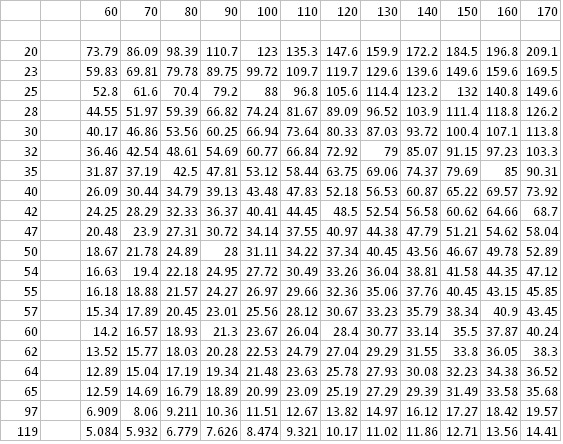
Here are tables from which inflation pressure can be computed. The rows correspond to tire widths, in mm. The columns represent rim width, as a ratio to tire width. E.g. the column with 2 at the top is for tire width twice the inner rim width, e.g. a 50 mm wide tire on a 25 mm wide rim.

The tables give the area in square inches of the contact patch. To compute the inflation pressure, divide the load on the wheel by the area of the contact patch. E.g. a 50 mm tire on a 25-559 ETRTO rim will have a 2.06 sq in contact patch when it is squished down 15% of its width. For that contact patch to support a 100 pound load, the inflation pressure should be 100 / 2.06 = 48.5 PSI.

For 622 BSD:

For 559 BSD:

For 406 BSD:

These tables are calculated purely from theory, i.e. no parameters are used to fit them to any experimental data. Do not follow them blindly! They're food for thought & perhaps provide a useful starting point for exploration.

And a 305 BSD table:

Sunday, November 15, 2015

Bicycle Tire Shape

Somehow I am rather fascinated by how bicycle tires work. Probably one reason is that I just enjoy how things that seem very simple before being analyzed, turn out to be rather complicated as they are studied more carefully.

A tire on a bicycle or car etc. must support the vehicle, which involves forces parallel to the radius of the wheel, and also transmit tangential forces from engine torque or braking. To support the vehicle, the tire must push down on the ground with its share of the weight of the vehicle, and also push up on the rim with the same force. If one lifts the vehicle up off the wheels and then gradually lowers it back onto the wheels, the tires will deform from a uniform round shape to a flattened shape.

How much deformation will occur, how deeply will the vehicle sink after the tires first touch the ground until the tires are supporting all the weight? This amount of deformation must satisfy two conditions: the area of the resulting contact patch, times the air pressure inside the tire, must combine to produce sufficient force against the ground to support the vehicles weight. But the deformation must also provide enough net force against the rim to support that same weight, as outlined in Jobst Brandt's article.

At first thought, the deformation looks like a single variable, determined by the height of the rim off the ground. The lower the rim, the more the tire is deformed. But how can a single variable satisfy two conditions, without an impossibly unlikely stroke of luck?

Thinking about this a bit more, it seems that at a given height of the rim off the ground, a range of tire shapes is possible. This range of shapes provides the flexibility for both constraints to be satisfied.

In the following diagram, C is the half width of the tire carcass, i.e. half the distance from bead to bead along the carcass. Where the carcass is not touching the ground it is assumed to have a circular shape. This is still a very simplified picture, because there will be interactions between the neighboring cross-sections of the tire. A very large radius of curvature will permit a large contact patch, increasing the force of the tire against the ground but reducing the lift of the rim. A small radius of curvature will reduce the contact patch, so the force of the tire against the ground is smaller but the lift of the rim is greater. The actual shape should be where the two forces are equal.

Monday, April 6, 2015

Pilgrimage

How about a bicycling pilgrimage of the Buddhist temples of the Catskills and the Mid-Hudson Valley?

It'd probably end up being about 400 miles, with plenty of hills. Perhaps ten days would be a reasonable schedule, leaving a bit of time to spend at each temple. The next challenge is to find places to stay. There are a few New York State campgrounds not too far:

Here is a nice map of New York campgrounds: Allstays

At Zen Mountain Monastery:

At Kunzang Palchen Ling:

At Karma Triyana Dharmachakra:

Initial route ideas:

Thursday, October 30, 2014

Adventure

Everyone needs a bit of adventure in life. Some folks surely get handed more adventure than they really need. But many of us manage to live lives of reasonably secure routine. Somehow connecting to the vast world that is beyond one's control, that is a very valuable way to stimulate awareness and curiosity.

Adventure needn't involve travel. One can try cooking new styles of foods, or learning a new craft or a new language, etc. And of course much travel is very routine, lacking in any dimension of adventure. But adventure travel is surely a classic and effective way to shake oneself out of the daily routine.

Adventure travel needn't involve huge distances or great risk. Alastair Humphreys has proposed microadventures as an approach to adventure that can be challenging without being extreme.

Adventure is really about discovery. Discovery always involves some degree of challenge, as it represents a confrontation with the unknown. Probably every adventure involves learning about oneself as well as learning about the world, though the proportion surely varies with the specific type of adventure.

A goal is an important, even essential, aspect of an adventure. It is a goad that drives one out of one's comfort zone. Finding or creating a goal that is effective, stimulating and motivating without being overwhelming and discouraging: that is certainly a central puzzle of adventuring.

Sometimes a goal just falls into your lap. My friend David handed me a map from the Rondout Valley Growers Association. The map identifies some twenty-odd local farmers and other small businesses. Each business has a supply of its own stickers. By visiting the business, one can receive one of their stickers which one can affix at that business's spot on the map. I love exploring the local area on my bicycle. What could be more natural: ride my bike to collect those stickers!

I have been at the project for several months. Sometimes I will figure out a route that lets me collect several stickers. Other times a few weeks will go by when I barely get out on my bike, never mind the stickers. Some businesses can't find their stickers... sometimes the person on duty doesn't even know about the map and sticker program. I have been bringing along a pen: if I make it to the business on my bike and the stickers are not at hand, I just ask the person there to mark my map somehow with the pen. Good enough for me!

Today I collected three stickers, which leaves me with only two more to go. I rode to the Catskill Native Nursery,

to Kelder's Farm,

and to Flying Change Farm.

With fifty miles of riding, those brief visits were only part of the adventure! Lots of beautiful scenery: Lower Sahler Mill Road,

and Airport Road.

Here's today's route:

Wednesday, June 5, 2013

Bicycle Tire Pressure

(I have done some more recent work on this: Rotta Model)

Proper bicycle tire pressure is a topic of endless fascination... and endless debate! On the one hand, what exactly is the goal? It is probably some combination of efficiency, comfort, handling, durability, etc. But the optimum pressure for reaching that goal will depend on many factors: the tire itself - its shape and construction - the load one is carrying, the surfaces on which one is riding, etc.

Frank Berto did some analysis, appearing here and here. Surley makes bikes with very fat tires and has some nice discussion about tire pressure here. There is also a thread on the Thorn forum, where I worked out a hypothesis that, using Berto's "uniform drop" theory, should vary proportionally with the load and inverse proportionally with the 3/2 power of the tire width.

I came up with a constant of proportion to give a reasonable fit with the published graphs by Berto. The fit is not very exact though... whether my formula gives better pressures than Berto's graphs can be left as an exercise for the reader/rider. In any case my formula is easily evaluated for a wider range of loads and tire widths than Berto's graphs cover.

Here, then, is a table of suggested tire pressures. Across the top, find the load, in pounds, on the single wheel, e.g. roughly half the total load on the two wheels of a bicycle. Along the left side, find the width of the tire in mm. The number at the corresponding column and row of the table is then the suggested pressure in psi. Click on the table to get the full image which includes higher loads.

Friday, December 16, 2011

Bikesteading

However dazzling the visions science gives us, of cosmology or microbiology etc., of at least equal importance is its practical value in helping us figure out how to live more comfortably, more successfully. Two questions then arise immediately. Is science tied to any particular measure of success? And, compared to what alternatives will science make us more successful?

For generations by now our cultural trajectory has blinded us to these questions. Science has enabled progress: every generation has lived more successfully compared to previous generations. Our success is obvious: just look at our amazing capabilities to build machines, to steer the wealth of the world to our purposes. Slowly though dissatisfaction with this trajectory has been growing. Also growing has been the effect of this trajectory on the world, as our growing human population meets tightening resource constraints. Ideally our thinking could lead the way to more sustainable ways of living, but it looks more and more like resource constraints will be the driving force.

Will our belief resist this change in thinking, our belief that science will put more and more resources at our disposal with every generation? Or can science help open our eyes so that reality can inform out beliefs. We can use science to live more successfully than we will if we cling to our blindness, but that is only a possibility.

The relationship between two discussions on the web highlighted this challenge for me. Dmitri Orlov talked about the ability "to abandon who you have been and to change who you are in favor of what the moment demands," while a thread on Bike Forums puzzled over a fellow who lives on his bicycle. Is Fred a bicycle tourist or a homeless person with a bike?

Orlov talks about seasteading, living on a sailboat. (I gather he walks his talk!) In honor of Fred, I would like to introduce the term "bikesteading".

A bicycle is surely a pinnacle of scientific technology. Bikesteading might not be the perfection of sustainability, but it might be one excellent response to the reality we're facing in the coming decades.

Thursday, October 28, 2010

A Few Decades of Bicycles

When I told my friend David that I have my eye on a new bicycle, he asked if this fascination with bikes was a new thing. That got me thinking about my bikes and biking over the years, so I thought I'd put some of that into words.

I lived in England with my parents and siblings in 1965 and 1966. That was a major watershed. My childhood memories are clearly divided into before, during, and after. I was nine years old when we moved to England, so I was already a bit of a big kid and enjoying bike riding. I still have my bike license plate from 1964. I must have had a coaster brake single speed bike, but I remember nothing about it. I do remember riding down Elmwood Ave. to the other end, which must have been all of twenty blocks! But that freedom to explore is a memory I still cherish.

We got two bikes in England; they must have been for my sisters. I remember my older sister's bike especially, because it had a front hub dynamo. They've been around a long time! And both bikes had hand brakes. Those were really nice bicycles! I spent most of my time in a boarding school there and didn't ride much at all. I do remember a bit of riding on the left side of the road, borrowing my older sister's bike.

When we moved from England back to Ohio, to Bath, somehow I caught the trend and begged my Dad for a Schwinn Sting-Ray. He was generous enough to indulge me - a five speed derailleur with a monster shifter on the top tube. But soon after that I met my best friend of those days, Mark Laessig. Mark died tragically young, at maybe 27. I was in contact with him shortly before cancer took him, when he was designing supersonic jet engines at NASA. But even in 8th grade he was obviously brilliant. Somehow in 1969 he had some kind of real racing bike, with drop bars, toe clips, and Campagnolo shifters front and rear. I only had that Sting-Ray a few months before I pulled off the banana seat and replaced it with something much more conventional. The high rise bars got pushed far forward to get me into a conventional posture.

Oh, I rode that bike a lot! Just to ride to Mark's house was a good ride - up Bath Hill, to start with! The biggest ride I remember was Mark and I riding to Nelson Ledges State Park. Looking on a map now - wow, that was over 40 miles! I bonked on the return trip and Mark's Mom rescued us, so it was probably only a 60 mile day. With some hiking and bouldering in the park, too!

Over Spring Break, 1969, we moved to Lake Forest, Illinois. Kiddle's was the bike shop there. I am proud to say that my first W-2 was from Kiddle's. I didn't work there more than a few months. The owner even offered to send me to the Schwinn Repair School in Chicago! But, sad to say, we were already planning our move away from Lake Forest by then.

Soon after our arrival in Lake Forest, I got the Raleigh catalog from Kiddle's and studied it thoroughly. I decided the Super Course was the bike for me and somehow saved up the money to buy one - surely with help from my parents, though I sure don't remember the specifics anymore! I know I rode that bike to summer school and over to Lake Forest college all the time. A side note - that was at the beginning of my computing experience - I was a regular on the IBM 1130 at Lake Forest college. I was fascinated by the closed solutions for cubic and quartic equations and had those written up in Fortran. I don't think I ever bothered to check my solutions, though! I try to do better nowadays!

The really big ride I remember from those days was a three day camping trip. I think there were four of us: John Gwynn, John Evers, Mark Recktenwald, and myself. We rode from Lake Forest up into Wisconsin, somewhere around Lake Geneva. We all would have liked to visit the Yerkes Observatory there but we just didn't have time. We must have been a sight, our tents and sleeping bags crudely strapped on our bike racks! I remember pulling into a Wisconsin State Campground in the dark, and the ranger's office was closed. We were all top students, but I think Mark was deputized to write the note: "We, a group of campers..." We found the picnic area and set up our tents well away from the RVs with their blaring radios or whatever people used in 1970. I also remember riding with a stomach ache from eating under-cooked pancakes from our campground breakfast. Were we cooking with Sterno?

In 1971 we moved to Fort Wayne. My main riding partner there was Mike Short. Ah, I remember attempting a century then. I bonked at about mile 85 and took the sag wagon the rest of the way. I had the patch from that ride on the knee of my blue jeans for a few years after: "I rode to Hell and back!". I hear there's another town not too far away, also in Michigan, that's called Nirvana. We didn't get there, though! I remember too riding many times from our house in the southwest suburbs, down US 24 past the intersection with I-69, into the center of Fort Wayne, to hang out at the library. I got some good use out of my Super Course!

In 1973 I left home to go to college at Princeton in New Jersey. I locked my bike up in the cloisters of Holder Hall with a cheap cable lock and didn't really ride at all or pay attention to the bike. I guess it was early spring before I noticed that the bike was gone. It was a nice bike but I hadn't been riding it so it wasn't a huge tragedy.

I think it was at the end of first semester sophomore year - my physics lab partner told me he was selling his racing bike. He was upgrading to a Masi, as I recall. Wow, the bikes that were appearing in those days! So I bought his Legnano. Campagnolo Nuevo Record derailleurs, center-pull brakes - probably Weinberg - and sew-up tires! I think I bought that bike immediately after Christmas break. I took it out on a ride... all the way out, a freezing rain began. I remember coming back toward Princeton on Route 206 and slipping and falling and landing sprawled out on the highway. It was busy enough with tractor-trailors and every kind of traffic, but somehow right that moment an angel must have been watching. I got back up and tried to walk with the bike but the road was so slippery I couldn't even walk on it!

Probably my longest ride in Princeton was out to the ocean, to Asbury Park. I remember riding over through Lambertville and down along the Delaware River, too.

Ah, the summer of 1976, I worked out in Grand Junction, Colorado. I was doing some programming work for Ken Deffeyes and Ian MacGregor, two geology professors. Mostly we'd commute by car, from the Mesa College dormitories where we stayed, to the ERDA labs where we worked. But for a week or two I was on my own. I recall that I borrowed a bike from one of the ERDA administrators for my commuting in that interval. I remember riding a bit on the back roads around the edges of Grand Junction.

I moved to Philadelphia in 1977 for graduate school. I remember taking the Legnano out for longer rides - sometimes for laps of the classic East and West River Drives, other times out to West Chester or Paoli. The Legnano isn't any kind of urban utility bike, though! I know I used a variety of old coaster brake bikes that seemed to appear out with people's trash from time to time. I remember riding no-hands in the middle of the night on one such bike, from 3rd and South St., after seeing some jazz, back to home in West Philadephia. Riding no hands up over the South St. bridge was the biggest challenge but not so difficult. I really pooled my pennies at one point and bought a new Panasonic five-speed urban bike. This bike was a bit of a technology experiment - the freewheel mechanism was in the bottom bracket, so you could shift the derailleur while you were coasting! But this bike got stolen after less than a year. Better to use a junk bike for running errands!

In 1982 I moved up to Poughkeepsie, NY, to work for IBM. My Dad loaned me his Schwinn Collegiate 5-speed bike to get around until I could afford a car. I remember riding that bike from downtown Poughkeepsie, where I lived, to the IBM education building south of the main site. I remember holding a duffle bag with my laundry across the handlebars, riding to the laundromat. How long did it take me to get that Schwinn back to my Dad? I still had the Legnano then, too. I remember riding up to Rosendale and then around the back side of the Shawangonks and then up and over, by Mohonk Mountain House. That Legnano did not have low gears! I remember riding up to Rhinebeck, too.

I spent a year or so in Cambridge, MA, in 1991. Already I had some kind of mountain bike. I remember riding that in Dutchess County a bit and how much more work it was to ride than the Legnano. But for the potholes and trolley tracks of the Boston area, the mountain bike worked great. I doubt that I even brought the Legnano to Boston - it must have stayed in Poughkeepsie.

I was on a long meditation retreat from late 1992 through early 1996. I stored a lot of my stuff but I sold a lot too - both the mountain bike and the Legnano moved on. My sister worked for a while at Bicycling magazine in Emmaus, PA. I think that's where the Legnano went.

I headed to the Portland, OR, area after retreat. I was low enough on funds and Portland looked like a good bike riding town, so my plan was to do without a car. I stayed a month or so beforehand with my sister in California. I found a Trek 520 there and had it shipped up to Oregon. I wish I had waited and bought my 520 up in Oregon, but I wasn't sure what would be in stock etc. and I didn't want to risk being without wheels.

The 520 served me quite well in Portland. I could ride over the West Hills from Hillsboro, where I lived, into downtown Portland, load up with books at Powell's, and haul them home. Usually coming home I would take Terwilliger and Beaverton-Hillsdale Highway. Up and over Cornell going west with panniers full of books - too much for me! I remember too some rides into the countryside. I especially remember my one ride up Laurelwood Hill. I had no idea what I was getting myself into! But it was a clear day, and at the top I was rewarded with a spectular view of five peaks - Ranier, St. Helens, Adams, Hood, Jefferson. Wow!

Somehow in Portland - well, I had a good job and so I could afford it - but I worked my way up to three bikes: a folding bike and a bombproof Amsterdam city bike along with the 520.

In 2007 I moved back east, into the Catskills Mountains. Lots of busy narrow twisty roads here! But slowly I am working out routes to get places while avoiding the most dangerous roads. This past spring I was delivering census questionnaires. My sweetheart's teenage son has a mountain bike which I used for a decent fraction of the work. Those fat tires and low gears are really handy for the private roads that snake up the valleys here! So that has got me thinking about a bike I can use for grocery shopping, for hauling real cargo up the mountain slopes - up Dug Hill Road!