Showing posts with label Science. Show all posts

Thursday, September 10, 2026

Cyclic Engagement

We don't act mindlessly, though we might act distractedly. But there are many ways to pay attention to what we're doing. I can just take my bicycle out for a spin around the neighborhood with no route in mind. Just turning in whichever direction I feel pulled, I can end up going down new streets and discovering parts of town I never knew about. Where I live there are a few old houses tucked among much newer houses according to no pattern I know. Well, one time I did a bit of research and found that the old Lincoln Highway passed through one part of town, so that explains the older houses along there.

This serendipitous wandering approach has its limits, though. It's not hard to end up quite far from home as the sun is going down! If I can keep track of the general direction in which I have been heading, and I know what time I left and what time the sun goes down, I can just keep an eye on the time and turn around to head home so I get there before dark. I can avoid busy streets unless I know a turn comes soon onto a quieter road. I can keep a weather eye out so I carry a jacket if rain looks likely. A water bottle is a necessity on a ride of any length, but then I should be setting out with some idea of how long I will be riding. Well, too, I need to be telling my wife how long I expect to be gone, so she doesn't get to worrying. There is a place for pure serendipity, but more commonly some rough sort of plan is needed.

Plans are good, but they often need to be flexible. There are many situations that can come up along a ride that indicate a change in plans is called for. A change in plans can be a shift into a more serendipitous mode, but I can also set out with a sort of network of route possibilities and criteria for deciding which to take as the ride proceeds. I might plan to ride to the grocery store to see whether they've got a particular product in stock. If I can get some there, then perhaps I will just head back home. If they're out at that shop, then I will head over to the next shop to try my luck there. Unless those rain clouds intensify, in which case I might head home anyway and try again tomorrow, assuming the weather clears up. This sort of network of plan fragments is a strategy, as the term is used in game theory. I don't know exactly what moves I will make, because I am not in total control of the situation. But I know what sorts of situations I might encounter along the way, and I know how I will respond for each of these possiblities.

To know all the different sorts of situations that might arise, that's a tall order! The world is full of surprises! One way to avoid surprises to to delay action until all the reasonable possibilities are understood... but that might be a very long delay, long enough to make whatever goal unachievable! Another way to avoid surprises is simply to be blind to them. One might manage to blunder through despite all, but more often this kind of blindness results in disaster. One can take a purely serendipitous approach to surprises, but that is not necessary. The unknowns are not all unknown. One can plan to learn. One can structure a journey using a variety of shorter explorations. These shorter explorations can limit the risk, so disaster is not so likely. But these explorations let us learn more about what situations can arise. Part of the journey is learning how to make the journey. The lessons shape the strategy, the strategy shapes the plans, the plans shape the lessons.

Why have we set out on such an expedition? Do we just want to see what we can see? Or do I need to get from point A to point B? I could be exploring for a place to engage in some profitable activity, for a forest were I can forage for mushrooms, for a farmer's market where I can busk, etc. Along my journey, though, my ideas of what I want might well change. My plan was to ride from Los Angeles to New York, but I discovered a violin maker in Des Moines and decided that an apprenticeship was my real way forward! My plan was to climb a Himalayan Peak but I became a tea merchant in Darjeeling! My plan was to sail around the world, but now I am working to protect lemur habitat in Madagascar! The goal shapes the journey; the journey shapes the goal!

It's not just that my journey involves discovering new goals. My journey makes me who I am. I am not the same person that I was when I set out! I am wearing clothes that I found along my way. I am telling the stories that I have heard along the way. The very shape of my body, my muscles, callouses, scars, etc. are the product of my journey. The I that started with one goal is not the same I that now has a different goal!

It's possible to resist this kind of fluidity. Once I have my made my mind up about something, I can just hold on and refuse to change. None of us lives so very long, after all! Holding on doesn't have to be forever, but just long enough. Ah, but even by holding on, that rigidity itself evolves. Our bones change their shape in response to habitual muscle tension! So in the end we cannot avoid a kind of serendipitous wandering approach to life. We can accept our own fluidity or we can refuse it, but that refusal is just another form of wandering.

We have come full circle, from serendipitous wandering back to serendipitous wandering. It's not a closure - it's an opening! This fluidity of my own evolution... I can start looking at ways to steer it toward more interesting neighborhoods, and ways to avoid the nastier surprises like getting caught in storms. This whole structure is a sort of helix, plans, strategies, lessons, evaluations... like a spiral staircase connecting level to level... the levels guiding and informing each other. What our lives are... incomprehensibly vast!

Monday, February 2, 2026

Just Keep Going

The piece I posted a few days sounded fun enough, so I thought I would make another piece in the same tuning and scale:

87edo 4x4x4x4 scale 26.

Both pieces have 256 measures. The earlier piece had the pieces arranged in a 16x16 square, which provides plenty of room for wandering around the tuning space. The 4x4x4x4 arrangement of the new piece constrains things to be more orderly, to provide more structure for the ear to recognize. This piece is also a snapshot of the thermodynamic evolution at a somewhat cooler point relative to the phase transition, which should also provide more structure.

My fascination with phase transitions goes back to my sophomore year in college. Professor Stephen Schnatterly gave a wonderful demo of an inverted pendulum showing a transition and spontaneous symmetry breaking, as an analogy for a phase transition. That got me to look into Stanley's book Introduction to Phase Transitions and Critical Phenomena. In that book there are some images from a computer simulation of the Ising model. Nowadays, of course, computer simulations are not so exotic as they were in the early 1970s! Professor Dan Schroeder has a nice one on the web: Ising Model Simulation.

My interests in software and phase transitions led me to work under Professor Elliott Lieb for my first semester junior independent research. Lieb's idea was to look at the partition functions for lattice gasses. Lattice gasses are similar to the Ising model. Their partition functions are polynomials. If the zeroes of these polynomials approach the positive real axis as the size of the system increases, that would be a sign of a phase transition. Lieb pointed to a theorem in Marden's book Geometry of Polynomials: one can construct a set of matrices from the coefficients of a polynomial; if the determinants of these matrices all have, hmmm, some particular sign, then the zeroes of the polynomial will be in the negative half plane, i.e. will not be anywhere near the positive real line. If I could compute these determinants from the partition functions of larger and larger lattice gasses, and they all showed zeroes in the negative half plane, well, that'd be good evidence that lattice gasses don't have phase transitions! Ha, I do wonder how much of this am I remembering correctly!

So my research project was to compute determinants for a bunch of largish matrices. I had told Lieb that I was a computer programmer. Well, one with very limited skills, it turned out! The textbook formula for determinants has a daunting computational complexity, growing as the factorial of the size of the matrix. That's the formula I ended up using, which limited me to very small matrices. That was pretty much the end of my physics career!

Here's a curious later development, if anyone wants to pick up the ball. Some 25 years after that disastrous semester, I found myself once again in the land of large matrices. I don't remember the exact details, but we were computing reached states in finite state machines, using binary decision diagrams. Professor Edmund Clarke noticed a similarity to Gaussian elimination in sparse matrices. His observation led me to the theory of Tree Decomposition, a part of graph theory.

Gaussian elimination is how one should properly compute determinants. Gaussian elimination can transform a matrix to half-diagonal form, and then one simply multiplies the matrix elements along the diagonal. Gaussian elimination can still be a bit costly for large matrices. If the matrix can be kept sparse the cost can stay low. Tree decomposition is a way to see how the sparsity of a matrix can be preserved during Gaussian elimination. Tree width is the measure of this preservable sparsity.

So here is a grand research proposal: those matrices of Marden, whose determinants I was to compute - how does their tree width grow as the size of the lattice gas system grow? Ha, I am still trying to salvage my physics career, fifty years later!

Here is someone poking around in this general territory, as a starting point: Phase Transition of Tractability in Constraint Satisfaction and Bayesian Network Inference

Thursday, March 20, 2025

The Radicalism of Modernity

A friend pointed me to this wonderful physics video. I've only watched the first few minutes so far - the whole thing is almost five hours long! It looks like it will be a delightfully informative five hours! Already at the beginning, from 4:00 to 5:00, a fundamental concept of physics is presented. If we want to get to the fundamental, essential laws of nature, we should take as a starting point an isolated, clean, pure state, a vacuum. I have the impression that the video will be showing us a state that is even cleaner and purer than a vacuum! But I want to head in a different direction.

The Copernican revolution shifted the center of the universe, the perspective from which we can access the essential laws of nature, from the earth to the sun. Giordano Bruno was more profoundly revolutionary: he proposed that the universe does not have a center!

I would like to propose a similar scientific revolution. The center being debated by Ptolemy and Copernicus and Bruno is a location in space. The starting point that Richard Behiel is referring to in the video is not a location in space but a state of matter, in particular a state of absence of matter. From a vacuum, the fundamental, essential laws of nature become apparent. Purity reveals essence. I want to argue that purity is not any particular state. It is true that some situations have a kind of purity that allows clearer revelations of natural law. But there are very many such pure situations, each revealing their own particular species of natural law. There is no uniquely pure situation, no uniquely essential natural law.

I first understood this from reading the book Elementary Excitations in Solids by David Pines. The pure situation here is a crystal, a regular arrangement of atoms. In a crystal, the sorts of elementary particles one finds are different from those found in a vacuum. The most basic such particle is a phonon, the quantum unit of a sound wave. There is no sound in a vacuum!

Our starting points for causal analyses are very diverse. If my automobile engine is mis-firing and I want to understand why, to trace the causal chain back to the big bang through the supernovas that created the metal atoms that condensed to form the earth from which the ore was extracted to allow the casting of the engine block that is mis-firing... however accurate this analysis might be, its complexity is not likely to point me to the need to replace the spark plugs! Instead, the pure state that I should start with would be a properly functioning engine. I can then look at how a disruption to that pure state, e.g. fouled spark plugs, can lead to observed effects like mis-firing.

Physics is the cornerstone scientific discipline, and science is the cornerstone discipline of modern times. The idea that an isolated clean state is the purity on which our analyses should be founded, this is the radicalism that becomes translated onto the political plane. The French Revolution is the paradigm case. The calendar and the units of measure were restructured from rational principles, cut off from tradition. The isolated clean starting point is remote from the tangled web of our immediate experience. We have prioritized what is distant over what is near.

This is not a sustainable approach to managing the world. What we neglect inevitably declines. If that decline really matters, we will generally pick up the pain signal, turn our attention to the decline, and take corrective action. But if we have a strong bias, if we are wearing blinkers that restrict our analyses to remote perspectives, our lack of attention can allow the decline to intensify to the point where it becomes much more difficult to correct.

We can think of earth as just one planet among many: this is a perspective that prioritizes the remote. From this perspective, what happens on earth is not very important. If we think of earth as our home, as our life support system, then what happens on earth is not so remote. It becomes important to look for ways to correct any declines we might observe; it becomes important to pay attention to any possible declines.

A physics-based approach to healthcare is also problematic. We can think of human functioning as some kind of swirling bag of chemicals. A human being is very far from the clean pure state of a vacuum! We can try to understand a disease as a pattern of biochemical reactions, but just to understand health as a pattern of biochemical reactions is already a challenge that is beyond our forseeable grasp. But we can shift our perspective to health as itself a pure state, and study the natural laws that are revealed from that perspective. It's not that the biochemical perspective is wrong - my point is that the biochemical perspective is not uniquely right. There are many sorts of pure states, each providing a perspective that can reveal natural laws specific to it.

Looking at Jupiter through a telescope, one can see its moons orbiting around it. Jupiter and its moons form an orbital system. It is natural to take Jupiter as the center of the universe when studying the orbits of its moons. In just this way, the pure system which can be disrupted, the effects of whose disruptions we can observe: what we should see as a pure system will depend on the problems that we are encountering. If we can remain sensitive to problems and able to shift perspectives so we can analyze problems relative to a normal functioning, where that relationship connects to our ability to respond, then our analyses can empower us to steer away from disaster.

Saturday, December 7, 2024

Health Science

The exact reason for the assassination of UnitedHealthcare CEO Brian Thompson may never be known, but it has certainly brought into focus the widespread frustration with medical insurance. The reluctance of insurers to pay for medical care care often enough means that people fail to get proper medical care, leading to pain, disability, and early death. Medical expenses drive many people to bankruptcy, despite their having medical insurance that on the surface should have prevented financial disaster. The medical insurance industry is generating tidy profits. Thompson's compensation was $10 million per year, and no doubt other top executives are similarly well off. There is a clear imbalance between the benefits to executives and stockholders, versus their customers.

Of course, many corporations beyond the medical insurance industry are also biased toward shareholder profits and executive compensation, at the cost of the quality of the products delivered to their customers. What makes medical insurance special is the degree of need. Medical care is often a matter of life and death. But medical insurance is just one component of medical care. U.S. health care expenditures total $4.5 trillion. Private insurers paid about 30% of this, or about $1.4 trillion. About $0.25 trillion went to the insurance companies themselves, for expenses and profits. So medical insurance is about a 6% overhead on medical spending. The small size of this number doesn't reflect all the costs of the insurance industry: for example, they have a lot of control over who gets what treatment, and may make inefficient decisions. And of course the real bottom line is not financial, but people's health.

I have seen charts that compare U.S. healthcare costs and outcomes with those of other countries. It looks quite clear that the U.S. spends an enormous amount on health care, but does not get commensurate health care results. People often post medical bills on social media, with astounding charges, often for relatively routine procedures. Pharmaceutical prices are often prohibitively expensive. To some extent, the medical insurance companies are caught in the middle. People cannot afford to pay huge insurance premiums, but they often need very expensive medical care. The insurers have somehow to allocate available funds to the most necessary care. No doubt they do an imperfect job of it, but the task is really impossible.

Health care corporations are like any other corporation: they are controlled by shareholders whose goal is profit, return on their investment. What incentives can be put in place to motivate corporations to provide high quality products at fair, affordable prices... this is a general problem. Part of the solution is the competitive nature of markets. Part of the solution is regulation by governments or other supervisory bodies. Part of the solution is cultural, a matter of changing understandings and expectations among all the various players.

Health care is a vast network of businesses and practices. Ultimately, it incorporates everything we do. For example, workplace conditions create stresses that often result in strains and injuries requiring medical attention. If workplaces were less physically stressful, there would be less need for medical care. Health care starts at home. If people help each other catch problems when they are small, there would be less need for medical care. How much of our increased medical expense is due simply to the increase in people living in greater isolation, away from extended families, away from people who catch problems before they need professional attention?

My particular interest here is in the scientific facet of healthcare. Medicine is the supreme example of a science where pure science and applied science are inseparable. Modern science is founded on physics, the supreme example of a science where pure science and applied science are separable. This separation of science from its use bears much responsibility for our global environmental crisis. Modern science is essentially driving itself out of business. The environmental crisis and the healthcare crisis are both pointing to the need for a new kind of science, a new vision of science, where pure science and applied science are understood to be inseparable. Medicine is thus the proper foundation for this new science. The healthcare crisis represents the birth pangs of a new science.

Sunday, April 23, 2023

The Disintegration of Science

In the 1990s, the science wars were fought between advocates of science and folks who saw flaws in science. Nowadays, the science wars underway are between folks claiming scientific support for wildly differing claims. Does our global use of fossil fuels for energy have significant impact on the climate? Are covid vaccines safe and effective? Of course scientific progress is driven by debate, so perhaps these disagreements are healthy.

A healthy organism is constantly fighting off infections and other disturbances. The integrity of an organism is constantly under threat. For a while, various homeostatic processes manage to preserve that integrity, but eventually those processes are overwhelmed, and the organism loses its integrity. Sometimes this lack of integrity means the death of the organism, but it can also mean division into multiple separate organisms. Presevation of integrity and subsequent loss of integrity can happen at many scales, from single cells to cell colonies to insect colonies to human societies.

Science nowadays, for the most part, maintains a very healthy level of integrity. A key component of this integrity is the vision of scientific knowledge as a coherent whole. All the bits and pieces of our scientific knowledge fit together somehow, or eventually will. We're always discovering inconsistencies, but our processes of research and mutual critique keep these inconsistencies under sufficient control that the overall integrity of the system is not under threat. The loud arguments over e.g. climate change are a sore point, but they are certainly at a small enough scale not to threaten the entire system.

And yet... these superficial rashes could be symptoms of a larger systemic problem. Is the rough coherence of scientific knowledge something inevitable? What processes maintain this coherence? What could threaten this coherence?

The coherence of science is maintained by a kind of circulatory system. Information circulates: researchers publish papers but also exchange preliminary results, critiques of draft versions of papers, and also text books and other coordinated summaries of scientific knowledge. People circulate: researchers meet to discuss their work, but also visit each other's laboratories to collaborate on research. Students are trained in one research organization and then get hired to work in other research organizations. Equipment and materials circulate: measuring devices can be calibrated to common standards. Experimental samples are exchanged between laboratories.

What would precipitate the disintegration of science would be the breakdown of this circulatory system. Circulation is supported by the larger social context. Freedom of the press allows research results to be published. Freedom of travel allows people to collaborate. Free trade enables the exchange of equipment and materials.

These freedoms are the hallmarks of liberal society. Science and liberal society have emerged together since early modern times. A free market of ideas allows the best ideas to emerge. Basing policy on effective ideas leads to success and growth, to progress. This progress provides a platform for further exploration, leading to better ideas, more effective policies, and further growth. We have been riding this feedback loop for four hundred years. It's not just science that is coherent, but our global society.

The general pattern in biological systems is that growth is followed by decline. Perhaps this time it will be different, but that is a position that requires a lot of faith! Just as science, liberalism, and progress supported each other in a feedback loop of expansion, there are signs that the same feedback loop may be picking up momentum in the direction of decline.

Of course one can pick a measure of prosperity to support whatever argument one wishes to advance. But it really seems like the financial crash of 2008 is one we have not really recovered from. The rise of vehement anti-liberalism is largely driven by the failure of liberalism. We were promised progress but that is not what we are experiencing. The underlying cause for the lack of progress is probably our reaching various ecological limits, but that's not a message that sells. Science and liberalism have built their castles on progress. As progress falters, so will liberalism, and so will science. Liberalism maintained the circulatory system on which scientific coherence depended.

Of course change is the nature of things. How science might best maintain itself in a new dark age, that is one worthy puzzle. It is valuable to step back a bit, to try to think strategically. How things will unfold in the coming decades and centuries, it is impossible to foresee with any accuracy. What is more feasible is to consider a range of possible trajectories, and to prepare responses across some plausible range. Insurance policies, diversified portfolios, hedged bets: these are effective approaches to dealing with uncertainty. We need to bring these approaches into our investments in scientific research programs.

Thursday, March 30, 2023

Heat Pump Efficiency

Thermodynamics is a fundamental branch of physics. It gets a bit subtle: I find myself getting tripped up often enough!

The cornerstone of thermodynamics is the Carnot cycle, an ideal process for converting heat to work. It's a model for what steam engines do, for example. The Carnot cycle sets a limit on how efficient an engine can be: it is not possible to convert all the energy from heat to mechanical work.

A heat pump is simply an engine running backwards. An engine has heat flowing from a hot reservoir to a cold reservoir, converting some of that heat to mechanical work. A heat pump uses mechanical work to push heat from a cold reservoir to a hot reservoir. The amount of heat added to the hot reservoir will be the sum of the energy from the work and the heat energy removed from the cold reservoir.

To heat a home, one can use a natural gas furnace, or one can use a heat pump. The heat pump runs off electricity, much of which is generated from an engine running off natural gas. Energy is lost when the natural gas heat energy is converted to electricity, but then energy is gained when the electricity is used to heat the home. Since the heat pump is just an engine running backwards, these losses and gains are in some sense reflections of each other, and might seem to cancel out. But they don't!

The missing detail is that there are three heat reservoirs involved. The engine at the utility power generation plant has energy flowing from a furnace to the environment, converting some of that to electrical energy. The heat pump has energy flowing from the environment to the interior living space, driving that with electrical energy:

The two efficiency factors have inverse forms, but the numbers involved are different, so they don't cancel each other.

Plugging in some roughly plausible numbers, a graph can be generated for maximum effiency of the overall system as a function of the outside temperature. As the outside temperature warms to near the interior living space temperature, the round trip efficiency increases without bound. At cold temperatures, the utility's power generation engine can run more efficiently, but the reduction in effectiveness of the heat pump is more dramatic, so the overall effiency is reduced.

Friday, March 24, 2023

Aperiodic Tiling

I've been seeing reports of an aperiodic tiling. At first, I couldn't imagine how a tiling could be aperiodic. Now the pendulum has swung to the other extreme, where it seems trivial:

The tile is just a 1x2 rectangle. Mostly they are all placed vertically, but there is a line along which horizontal tiles are placed. One could interpret the pattern of absence or presence of a horizontal tile in the sequence of columns as expressing a fraction in base 2. If the fraction is irrational, the pattern will be aperiodic. Hmmm, even if there was just one horizontal tile in the middle, the pattern would be aperiodic!

There must be some trickier definition in play, of what aperiodic means. But anyway, now it doesn't seem so impossible!

Friday, March 17, 2023

Scientific Equipment

Galileo did not invent the telescope. Galileo looked at the night sky with a telescope that someone else built. Scientists do sometimes invent and build the equipment they need, but in general scientists take advantage of existing equipment to enable them to do science. Science is not a free-standing activity; it is an integral part of a much larger world. Science uses its connections with the world, just as the world uses science.

This relationship of mutual use creates a self-reinforcing feedback loop. Scientific discoveries enable new equipment to be constructed, and new equipment enables yet further scientific discoveries. The astounding technological capabilities of our time are the fruit of this system. However, the system is more complex. Our global-scale industry has global-scale impact on the environment. Climate change may be the most immediate concern, but we are seeing many other effects too. It is of course difficult to predict exactly how environmental limits will impact the availability of scientific equipment. But a starting point would be a reflection on the variety of ways that science uses what the world makes available.

Instruments with which to observe and measure natural phenomena are surely at the head of the list. Nowadays we have telescopes in orbit, detecting a wide range of electromagnetic frequencies: not just in orbit around earth, but around other planets too. And we have robots on the surface of Mars, observing at close range. At the tiniest scale we have particle accelerators and electron microscopes. Chromotography, spectroscopy, magnetic resonance imagery... a catalog of today's observation and measurement equipment would fill an encyclopedia.

Another way that science uses what industry provides is the acquisition of raw materials. All kinds of very pure simple and complex substances are available. There is also a rich variety of materials processing equipment by which raw materials can be processed to form both experimental samples and also custom observational devices. Vacuum pumps are a curious sort of equipment, since their function is to remove material rather than to supply it. But vacuum pumps are fundamental to preparing a suitable environment for observations, back to the time of Boyle at the birth of modern science.

Recording experimental observations can rely on little more than paper and pencil, though nowadays all sorts of automated recording devices make continuous accurate measurement and recording possible. A variety of automated analysis can be performed by computers, so the scientist need only attend to a summary report.

Science is a communal enterprise. Scientists compare results, critique each other's methods, exchange tools and materials, hire each other's students, etc. The worldwide transportation and communication networks make these exchanges possible. Scientists travel, too, to observe phenomena that occur at special locations, such as biological species in their native habitat, or geological phenomena in place.

Another sort of equipment that science needs is social. At the most basic level, there need to be scientists, people with the capability and freedom to pursue scientific research. The various physical equipment necessary must not only exist but be made available for use by scientists. For the self-amplifying feedback loop of scientific advancement to work, industry must be confident in the validity of scientific results so that the know-how produced by science will be applied to produce the next generation of more capable scientific equipment.

The reader is invited to augment this list. But a further exercise is to consider what impact environmental limits might have on any of these sorts of equipment. There could be other potential feedback loops that get excited as we enter some new regime of system behavior. It is not impossible that environmental limits push industry into less efficient processes, which accelerate the impact of those limits.

It seems clear enough that science has a large share of responsibility for creating our modern world, with all its miraculous technological capabilities. That is another facet of the self-amplifying feedback loop: powerful people understand how science has enhanced their power, and so they promote scientific research. We certainly seems to be at very real risk of entering a new regime, where our miraculous technological capabilities are seen instead as driving us ever more violently against environmental limits. Just has science earned support by taking credit, science may well lose support by taking blame.

Science is not a free-standing activity, but is embedded in a multi-faceted world. This relationship has been at the heart of modern industrial civilization, which is about 200 years old. We seem to be headed for a major shift. If science is to survive the shift in good health, the scientific community will need to find ways to adapt to the new patterns.

Thursday, November 3, 2022

Non-Euclidean Science

Maybe I should call it non-Aristotelean, or non-Platonic, but the exact name isn't the point. Euclid built geometry up from postulates; Aristotle explained motion as objects returning to their natural state; Plato portrayed experience as the shadow play of forms in an ideal realm. In each case, a complex field of phenomena is explained as the outgrowth of some simple essential foundation. Perhaps I should call my proposal non-foundational science. But I am not proposing any kind of freed-floating science. I am proposing a science that is founded on reality, on the vast tangled web of lived experience. Science is an extract, like resin extracted from the sap of a tree. There is a lot more to a tree than such resin. The tree itself is embedded in soil and climate, in an ecological web, flying pollinators and mycorrhizal fungi. The simple essence emerges from the whole, rather than the whole emerging from the simple essence.

Science as a quest for an inner key that explains everything - such science takes us on a quest into ever more remote realms. It distances us from experiencing what is right at hand. Of course, building and launching the James Webb infrared telescope surely involved considerable attention to experiences right at hand - precision torquing of many bolts, etc. Galaxies and quarks are not objects of direct experience, but neither are they disconnected from direct experience. What I am proposing is no neglect of any corner of the world. I am suggesting a shift in how we understand the way all the bits and pieces fit together.

Non-Euclidean geometry provides an excellent analogy. The surface of a sphere, such as the surface of the earth, is a perfect concrete instance. Euclidean geometry is plane geometry, the geometry of a flat surface. At the scale of a few square miles, the earth is extremely close to a flat surface, and can be mapped onto a flat sheet of paper with great precision. But as the area to be mapped increases to include a significant fraction of the earth's surface, inevitably distortions arise. There is no perfect flat map of the earth.

The impossibility of perfection does not mean that we just give up and produce fantastic maps that have lost any connection with the lived experience of moving around on the earth. The value of a map is exactly in how it relates to such lived experience. Whether a map is good or not, that depends on how the map is to be used. A map that is good for navigation will typically not be a good map for estimating agricultural productivity.

Pure science is science that neglects its relationship to its use. Applied science is science that orients itself to its use. The classical scientific attitude is that applied science grows out of pure science. I am proposing that a healthier approach to science is to see pure science growing out of applied science. Applied science connects to the vast complexity of lived experience. Refining our ideas requires chopping out local regions to be precisely mapped. This always involves distortion and omission: the inevitable price of precision. It's like taking a photograph: a fast shutter speed can reduce blurring from movement, but requires opening the aperture which increases blurring from less depth of field.

Our scientific quest for ultimate theories is like the old searches for the alchemical philosopher's stone or the healer's panacea, a medicine to cure all diseases. Good science requires following the clues wherever they lead, but it also requires a perspective on the actual situation so that one doesn't chase clues just for the sake of the chasing. Good science is science that is engaged with the lived reality of an actual situation.

Friday, January 7, 2022

Science without Progress

There's a notion of science for which progress is essential to science. Science is a process of steadily broadening, deepening, and refining our knowledge about the world. It's a process of steady improvement. This year's science is better than last year's science, and next year's will be better yet. Whether this process converges on some ultimate theory that captures precisely the way things are, that's a bit beside the point. The sequence of integers 1, 2, 3, etc. steadily get bigger, without ever converging on some final largest integer.

For this kind of steady progress to be the way science works, two things must be true. First, we need a way to compare our scientific knowledge at one time to our scientific knowledge at another time. We need a way to tell which state of scientific knowledge is better. Once we have that measuring stick, then we can at least check empirically whether science is constantly improving. We can develop some kind of model of the evolution of scientific knowledge, and check whether at least the model guarantees continual progress into the future.

It's easy to sketch out a model of the evolution of scientific knowledge that implies perpetual progress. Such a model may not be accurate, though! A major question in examining the dynamics of science is its coupling with the world outside science, with social, ecological, and geological systems. Science is a social institution, intimately connected with the rest of society. When sources of funding, materials, equipment, and personnel dry up, science cannot thrive.

One measure of the state of scientific knowledge is the size of the total accumulation of scientific publications. As long as some library somewhere continues to accumulate the mass of literature, as long as scientific literature is not lost, then scientific knowledge will continue to advance, by this measure.

There are two problems with this logic. First, it is unreasonable to expect all scientific literature to be preserved in perpetuity. It's not even clear what exactly should count as scientific literature. Parapsychology, the study of phenomena such as telepathy, is an example of a discipline whose scientific status has been debated. Should raw data accumulated by scientific instruments count as scientific literure? As our boundary that defines scientific literature changes, our measuring stick to detect progress is being updated. We don't have a consistent measure by which to determine whether science progresses consistently.

Even if we maintained a constant definition of what should count as scientific literature, it is not reasonable to expect all such literature to be maintained in perpetuity. There is some expense involved in preserving information. There is additional expense involved in converting old literature to new formats. Not all printed literature is scanned to digital form. Digital formats are steadily changing, and obscure literature will generally be given a low priority for format conversion.

Even if a record of some coherent piece of scientific knowledge has been preserved in a library somewhere, it can easily happen than no one is alive any more who can make any sense of it. The papers involved may easily refer to scientific instruments that no longer exist, for example.

One can slog through endless such details to determine whether scientific progress is inevitable. In the face of impending climate catastrophe and the profound social upheavals that will bring, the idea that science will somehow weather the storm despite all the challenges... perhaps no amount of detailed argument will convince a true believer!

If progress is essential to science, but if progress is not a secure ground on which to build... must science then crumble, too? Can science survive and even thrive without progress? Is progess, after all, essential to science?

It is a vital project to develop a vision of science that does not depend on progress. We in that part of the world that supports science are at grave risk for a major decline in our general level of prosperity. Science will participate fully in the trajectory of decline and collapse. If we can maintain a thriving science despite that decline, our ability to cushion that decline will be significantly enhanced. We will be better able to respond to recurring crises in medicine, agriculture, etc. If the scientific community cannot find a way to dance with circumstances, we will all suffer from that failure.

An analogy should be useful in developing a vision for science that doesn't depend on progress. Darwin's theory of evolution shows how species are constantly adapting themselves to their circumstances. The steady extension and refinement of scientific knowledge is similar to biological evolution. But biological evolution does not imply any kind of progress. Species today are not more advanced or better adapted than were species ten million years ago. Species ten million years ago were reasonably well adapted to their circumstances back then, which were very different than the circumstances of species today. Some of these changes are surely geological, but they are largely due to the interdependence of species, the nature of the ecological web. When one species develops some new characteristic, that changes the circumstances of other species, pushing them to adapt in new ways. There is no fixed measuring stick by which to determine whether one species is more advanced that some other species.

When we dream of some ultimate scientific truth and view science as a path leading to that goal, progress seems to be essential to science. But if we understand science to be a practical approach to engaging with our experience, enabling us to respond more effectively to our circumstances, then it becomes natural that our scientific knowledge must shift and adapt as our circumstances change.

Sunday, December 12, 2021

The Paradox at the End of Modernity

Modernity can be defined as a culture of faith in progress: newer can be better, should be better, is better. The engine of progress is science. Science is a process of refining our understanding of the world. We are constantly learning about the world, correcting our misunderstandings and extending the frontiers of our knowledge. Science doesn't go backwards. Tomorrow's science is better than yesterday's science. We can use our constantly improving scientific understanding to improve conditions in the world around us, to cure diseases, increase crop yields, etc.

This vision of progress based on science was elaborated by Francis Bacon in the early 17th Century, at the beginning of the modern era. The road of progress we can see in front of us remains limitless. Colonizing Mars, autonomous robots, the extension of life expectancy to multiple centuries and beyond... what barrier can we not imagine transcending? And if we can imagine it, step by step we can use the scientific method to resolve whatever problems limit our ability to achieve it.

On the other hand, as science refines our understanding of the world, it reveals some very challenging limits. Of course the way science understands limits on one day may be overturned the next day. Perhaps the rudest limit science has discovered is the speed of light. As the vastness of the universe has been revealed to us, so has its remoteness. Will we figure out some clever way to leap across distances of thousands of light years? This might be the most elementary form of the paradox we are caught in. An irresistable force is contending against an immovable object. What will happen?

Back down on earth, of course, the speed of light doesn't seem like anything worth much worry. We have plenty of technical problems with much more immediate impact. The general problem of global resources: climate change, water, biodiversity; this problem is foremost among our challenges. Pandemics such as covid-19 are to some degree a result of humanity running up against planetary limits, but there is also the problem of pathogens evolving to evade our countermeasures. Our problems can get worse more quickly than our pace of finding new solutions.

At this point, it is not too farfetched to observe that our progress in scientific understanding is revealing more about the limits to our technical progress than it is enabling further technical progress... "technical" meaning our ability to improve our world.

Nowadays it is very easy to find literature championing each of the two poles of this paradox. There are books that show how things have always been improving and will continue to improve. There are books that map out the trajectory of the collapse of modern civilization that we are riding along.

Will the irresistable force succeed in dislodging the immovable object, or will it be defeated?

Paradoxes, like the paradox of progress that we are caught in today, are not generally resolved by the victory of one pole over the other. In general some kind of deeper understanding of the apparent contradiction is required. A good starting point is simply acknowledging that we really are facing a paradox. It would be foolish to dismiss either the vitality of scientific progress or the reality of the planetary limits to growth. To develop a new understanding of our situation that can encompass these two aspects, that is the challenge we face.

I found Kurasawa's film Dreams to be a wonderful vision of how we got here and where might might be heading. The final segment is "The Village of the Watermills," where we see a joyful celebration of a funeral. Death is a reality. However over the top the visions of the colonization of Mars might be, the visions of human immortality make those look very tame. We really do need to grow up and learn, not just to accept our limited situation, but to cherish it. A joyful funeral is one way to do this. But how we age, that is another vital dimension. What can it mean, to be healthy and old? To be healthy and dying? Such a vision might provide a model for our modern civilization as it runs up against planetary limits.

Sunday, November 1, 2020

The Conduct of Emptiness

Buddhism and science share the view that much suffering is due to mistaken ideas about the way the world works, and that much suffering can be avoided by replacing those mistaken ideas with ones that better fit the world. The biggest difference between Buddhism and science is their general strategies for avoiding suffering. Shantideva’s analogy captures the difference. Walking barefoot over rocky terrain is painful. The scientific solution, or at least the technological solution, is to pave a smooth road. The Buddhist solution is to wear shoes. The focus of science is outward; the focus of Buddhism is inward. The more accurate understanding of the world provided by science allows engineers to change the world into a less painful configuration. The understanding of mind taught by the Buddha enables Buddhists to train their minds to respond to the world in less painful ways.

The Buddhist view of the nature of reality is not monolithic. In general, the idea is that the coarse objects of our everyday perception and interpretation, the individual persons and things of our everyday world, do not exist in the cleanly defined discrete way that they appear to. For example, careful examination of a cart reveals that it is just an arrangement of parts such as wheels, an axle, etc. As such analysis is pursued ever deeper, is there some natural stopping point, where analysis reveals some elementary discrete objects that cannot be analyzed any further? Over the millennia of the development of Buddhism, a variety of doctrines have emerged. The Madhyamika school, pioneered by Nagarjuna but also followed by Shantideva, holds that no such elementary objects can exist. Whatever object appears in our investigations of the world, that object can be further analyzed to understand how it arises from the interplay of other objects. Emptiness is a term used to refer to the way objects are never discrete, elementary, and unanalyzable. Interdependent origination is a term used to refer to the way objects arise from the interplay of other objects.

The distinction between the two ways to reduce suffering, changing the world versus changing the mind: this distinction is not so clear and discrete either. Effective engineering requires an understanding of the human mind. For example, designing safe and efficient roadways requires an understanding of how the human perceptual and interpretive systems will parse the various road markings. Mind and world are intimately coupled; indeed, each gives rise to the other: they co-emerge. The Buddhist path of mental transformation is not separate from actions in the world. Ethical and compassionate conduct is one of the cornerstones of the path, along with view and meditation. Cultivating the view of emptiness and interdependent origination is a classic meditation exercise. The view comes alive as it is reflected in one’s conduct.

This perspective flows into conduct mainly through the channels of alertness, curiosity, and sensitivity. Our actions arise out of our perceptions and interpretations of a situation. When we know that further analysis would surely alter those perceptions and interpretations, we don’t commit 100% to the interpretation of the moment. We remain open and curious. The new experiences that unfold as we act can inform us and give us fresh understandings so we can adapt and improvise.

There are classical teaching stories that illustrate the need for keeping our interpretations tentative. One story is about a farmer who finds a beautiful horse and the events that ensue. What first seems like good fortune then turns out to be misfortune; what first seems like misfortune turns out to be good fortune. Things are never quite what they seem.

A further channel for living the view of emptiness and interdependent origination is through community, through collective exploration. So much of our common conversation revolves around who is right and who is wrong. More productive discussion can happen when we understand that no one is altogether right and no one is altogether wrong. Each interpretation of a situation provides another perspective. We may need to take action, and so need to resolve a coherent interpretation on which to base that action. But we can work to act in a way that keeps open opportunities to learn more, for our interpretation to evolve, rather than closing down our perceptions in order to stabilize our interpretation, our actions reinforcing our justifications.

Wednesday, February 26, 2020

Pride and Fall

I was discussing interplanetary colonization with an acquaintance recently. I don’t foresee that in any likely near future, while my interlocutor is convinced it’s a near certainty. Opinions do differ! The discussion did degenerate, sadly, into ad hominem characterizations. I was put into the “genteel-poverty crowd”; I called my acquaintance a “technocrat”. He accepted the label gracefully enough.

Predicting the future involves some kind of model. The simplest common model is an exponential function. For example, the world population might be increasing at 2% per year. With that simple model we can forecast the population at any time in the future. Science is largely a matter of developing, testing, and refining models for various facets of the natural world, by comparing the various models’ predictions against real world experience.

How this whole dialectic interplay between theory and experiment actually proceeds, or should proceed, is a topic of endless discussion among philosophers of science. Scientists have got the orbit of the moon around the earth figured out with remarkable precision. Philosophers of science continue to struggle to come to any basic understanding of how that precise figuring has come about.

Immanuel Kant’s philosophy is a major waypoint in understanding how science progresses. His notion of synthetic a priori judgements accounts for the fact that models cannot be inferred directly from the data of experience. It seems clear by now that our thinking is more adaptable than Kant gave us credit for. But still, it often takes a succession of generations of scientists for a new conception to take root. Our ways of seeing the world are quite deeply rooted.

In my recent discussion on interplanetary colonization, my acquaintance made a remarkable declaration: “Technocrats don’t have preconceptions.” I don’t think this is any kind of unique or even unusual attitude. Most scientists dismiss philosophy of science as being irrelevant. Generally they take for granted a kind of direct insight into the nature of phenomena. The task of science looks, from this perspective, a bit like that of a surveyor mapping out a new territory. Probably even real surveying is a bit trickier than this kind of naïve notion would portray it!

Our modern civilization is built on science. Practically every facet of our lives has been explored scientifically. Our lives are, in turn, structured by these scientific models, be they mechanical, chemical, biological, geological, or whatever. It is quite easy to slip into thinking that we have pretty much figured it all out. The stable structures of our lives mesh neatly with the stable structures of our ideas.

It may be just my own preconception, but things do change. The notion of environmental constraints has been talked about at least since Malthus, a couple hundred years ago, but clearly we humans have been very successful in circumventing whatever limits have appeared. How long this run of success will continue… that’s one of the core controversies of our time. What interests me here is not this or that model on which to build a forecast. What interests me is how the shape of the future can appear unquestionable to the cultish wing of the technocratic faith. More precisely, how might this kind of blind faith affect our ability to navigate any turbulence in the coming decades.

There is a curious paradox here. The notions of Malthusian limits, of climate change, of turbulence on the horizon: these are all scientific ideas. Science forecasts change, but science is not really ready for change.

Supposing that we actually do run out of miracles and Malthusian limits do finally get their teeth into us. What’s the impact going to be? Will it just be a matter of maybe replacing our air conditioners with more efficient units? Or are we facing famine and plague and the decimation of the population? These questions have been discussed extensively. A question that gets much less attention, though: what will happen to science? Certainly there are deep visionaries in the scientific community who can foresee the coming turbulence and begin to sketch what a post-collapse laboratory might look like. But a large fraction of the members of the greater scientific-technocratic subculture share my acquaintance’s blind faith, I fear, in the eternal stability of the present system: a steady growth in watts per capita and the rest of it. This kind of blind faith will not help us navigate any sort of coming collapse!

Thursday, November 30, 2017

Goals of Science

Much of what gives science its particular character are its methods, such as the mutual refinement of theory and experiment, and cultivation of community through publications, conferences, the peer review process, etc. But science can also be characterized through its goals. What is science for? Why put effort and resources into science?

At the most fundamental level, science is about making our understanding of the world more accurate and more extensive. Science is exploration and learning. The result of science at this level is a community with a better understanding of the world and an increased capability to interact with the world.

At a more concrete level, science develops a map or picture of the world. Scientists document their understanding of the world not just as a tool to enable further exploration but also as a product or result. The result of science at this level is a collection of documents, databases, simulation programs etc., i.e. information about the world.

Even more concretely, science gives us the power to change the world: to cure diseases, to transform materials, to build airplanes and rockets, to communicate instantaneously around the globe. Whatever the problem, science can show us how to fix it. The result of science at this level is a changed world, a better world that contains medicines, machines, materials, etc. that make the world a better place.

Society changes and so does the institution of science. We need to prioritize our scientific efforts to maximize benefits within constraints. These three levels of goals should help us see that these benefits have a diverse nature. To some extent these levels are mutually reinforcing, for example one component of a better world is the availability of better laboratories which support enhanced exploration and understanding. On the other hand, for example, building a better world is quite expensive so funds will surely be diverted from exploratory efforts whose worldly benefits are uncertain. As political and environmental constraints tighten, these choices will become more difficult. A clearer understanding of their consequences should help us choose more wisely!

Tuesday, October 11, 2016

The Rational Animal

I read E. O. Wilson’s book Consilience around the time it came out, in 1999. I still find that kind of triumphalism annoying. It’s easy to doubt that “single vision & Newton’s sleep” can ever extend its reach to encompass the full range of human experience, as Wilson argues against Blake, but it is a bit more difficult to see where the obstacles lie. I recall Wilson explicitly addressing one potential limit, but I have never been able to find this discussion again. Did I just dream it? In any case, the puzzle arises out of the fundamental structure of the book’s argument: science gives us knowledge about the world of unprecedented accuracy; and science teaches us that human behavior emerges out of evolutionary pressures, the various claims of transcendence or nobility or rationality having little more validity than the chest thumping of an ape.

The puzzling questions that come out of these ideas are then: “Are not scientists humans? Do scientific theories themselves have no more validity than chest thumping? Since even the chest thumping theory is mere chest thumping, hasn’t science cut away its own foundations and left us floating?” In my dream-like recollection, Wilson responds that the scientific method has given scientists an escape ladder for transcending the human condition. Of course, this claim raises more questions than it answers, but I don’t recall Wilson taking the discussion any further.

Nowadays the popular image of science seems to be more and more tarnished. On the one hand, the great power of science has inevitably brought corruption, both real and imagined. For example, tests of drug effectiveness seem to succumb occasionally to the optimistic bias of the manufacturer. On the other hand, the huge stakes involved in an issue like climate change induce powerful economic and political forces to cast doubt on the scientific theories involved, however pristine the methods that generated those theories.

Can we ever free ourselves from our biases, to get a clear objective look at reality? Perhaps the most honest approach to science will turn out to look more like professional wrestling, a no-holds barred battle of ideas, where the results are determined more by back room deals than the circus on public display. This dichotomy between transcendence and baseness is not limited to our quest for truth. Can our efforts to act in a morally good way ever be free from our base urges, our greed and violence? Is all nobility and virtue really a lie, a mere disguise worn to hide a base grab for power?

The 2016 presidential contest in the USA seems to exemplify this battle between the hope for transcendence and the frank admission of our base nature. Clinton represents the bureaucracy that inevitably arises to administer and regulate our efforts to climb toward the shining castle of the good and the true. Trump represents the raw honest direct grab for power.

There does seem to be a generational cycle between these poles, a la Strauss & Howe. As we approach one pole, its flaws become very apparent, while the opposite pole presents the eternal illusion of the greener grass on the other side. Can we ever develop the wisdom to realize that every system has flaws, that real progress comes from working closely with those flaws rather than running away from them?

Saturday, April 2, 2016

Science Cathedral

I am spending a few days in Columbia, South Carolina, attending the conference Greening of Religions, sponsored by the Cherry Hill Seminary and the University of South Carolina. One attendee noticed a conflict between two views of science that have come up here. On the one hand, science is responsible for the disenchantment of the world that has opened the door to the environmental crisis that we are facing. On the other hand, scientific theories like ecology and evolution show the kinship of humans with other life on the planet, and the vital importance to human well-being of the well-being of those other forms of life. The observation of this conflict didn't elicit much response at the conference but it is central to my own thinking, my own calling.

In my presentation here, I had a few suggestions for ways to improve our thinking about and practice of science. I suggested that in evaluating the validity of a scientific theory, some kind of middle way is needed. Specifically I would suggest that validity should be something like a function from some parametric space describing a possible context of application of the theory, to some probability of satisfactory application. Roughly speaking, each theory has some large or small range of applicability.

My other suggestion was some kind of democratization of science. Sitting outside at lunch after the session at which I presented, I gave this idea a more concrete form. The way that science students really integrate science is through experiments, by repeating the classic experiments of their field. These repeated experiments are a lot like religious rituals, means to recreate core insights of a tradition. This parallel provides a direction that could work very well.

How about a science cathedral? It could consist of a set of chapels, each chapel dedicated to some classic science experiment. Each experiment could be repeated on a regular schedule, every day perhaps for some simple ones, once a year for complex ones. Each experiment could have a liturgy, starting with a description of the scientific question that initially gave rise to the experiment and some background for the people originally involved. Then as the steps of the experiment are executed, further liturgy would explain what is being done. Perhaps attendees could file by meters or flasks or whatever to observe voltages and colors etc. The ritual performers could wear costumes that reflect the time and place of the origin of the experiment.

Part of the program would also be to invite members of the community to deepen their participation, step by step. The idea is that people can really come to understand how the experiments work, to really share the insight about the world.

Of course some rituals would have to incorporate field work. Traditional religion involves parades and pilgrimages, so the parallel is still holding.

This vision is of course much like a science museum. But science museums tend to be rather dead. Science museums do tend more and more to provide hand-on opportunities. Perhaps a key difference is the focus of the science cathedral on the intent of experiments to induce particular insights. Once I was in a museum where Tibetan Buddhist musical instruments were on display, inside glass cases. Often enough I will play such instruments in ritual practice, e.g. at Kunzang Palchen Ling. It was really sad to see these instruments locked away in a case, away from their intended use. The museum could have provided a hands-on opportunity by leaving the instruments out of the case. But it is still a whole different experience to play a gyaling in a ritual, holding the intent in mind.

The more scientific practice gets isolated in ivory towers, the less it will be understood or trusted by the great number of people without the keys to those towers. It is vital for our future that we cultivate ways to bring scientific insights to the people, not just the technological products enabled by science.

Wednesday, October 21, 2015

Local Science

The past couple centuries have brought stunning technical transformations in almost every facet of our lives. The fruits we enjoy, e.g. internet access, are provided through complex networks of industrial processes that are based on very significant extraction of raw materials such as fossil fuels and metal ores, while at the same time emitting many waste products from carbon dioxide to solid plastic debris etc. A finite planet cannot support unlimited increases in rates of extraction and pollution. There are surely sustainable rates, at least for some materials, but these sustainable rates are very likely much lower than our present rates. Perhaps we will find much more efficient ways to provide the fruits we enjoy, so the rates of extraction and pollution can be brought down to sustainable levels without impacting our lifestyles. The possibility does seem quite real though, that change, by choice or necessity, will not be limited to factories. Changes in technology have changed our lives in the past, and seem very likely to continue to do so in the future.

A cornerstone of the modern transformation of our world is the feedback loop between science and industry. Advances in our scientific understanding of how the world works enable industrial processes to be designed to exploit that new understanding. In turn, industrial advances provide ever more powerful tools which scientists can use to probe more deeply into phenomena, enabling further scientific advances. But industrial power depends on more than science; it requires access to resources, legal and economic support, etc. If we are indeed entering an age of limits, industry will most likely be producing a significantly reduced range and volume of output. This will impact science.

What will science look like in a post-industrial world? Is there a range of possibilities? Can we somehow steer ourselves toward some happier among the alternatives? These questions are not limited to science, of course. Our entire way of living is going to be different in a post-industrial world. The way we live is both the way that we enact our choices, and a reflection of the outcomes of those choices. The same duality holds in science.

It may be a difficult idea, the notion that we have any choice in how we do science. Scientists observe the world and report on what they see. To the extent that science is such a direct and honest mirror of reality, introducing a notion of choice seems to imply some suggestion of departure from the whole truth and nothing but the truth. But science is an active human process, steered by choices at every step. For example, at the most intimate level, a scientist decides where to focus their attention. At the social level, various institutions decide which scientists and which research projects to support.

One way that people are responding to and respecting resource limits is to return to a more local way of life. This means less reliance on trade across great distances, and cultivation of richer person to person relationships with local community. When we rely less on local community, we rely more on large bureaucratic institutions. These institutions tend to be blind to the rich details of people’s lives and to focus on just a few bottom line statistical summaries. Large institutions also concentrate power, which generally fosters a greater degree of corruption, where the institution begins to promote its own welfare above that of the public it is intended to serve. Such corruption often involves distortion of the measures of the institutions effectiveness, steering institutional action to its own benefit. This kind of institutional blindness surely deserves a significant share of blame in our inability to respond effectively to the various challenges of resource limits. The benefits of resource exploitation tend to be channeled more to those in power, while the costs are channeled to the powerless. Withdrawing support from these institutions can be both a way to reduce the planetary impact of resource exploitation as well as an adaptation to narrowing limits.

Science is in many ways a typical facet of life, having become ever more tied to large bureaucracies. Science needs to change, both to reduce planetary impact and to adapt to limits. But science has a deeper connection to global institutions. A cornerstone principle of modern science is the notion of the uniformity of scientific law. For example, helium atoms in a terrestrial laboratory will behave the same way as helium atoms in a distant star, so we can learn about the behavior of stars through experiments in a laboratory. If observations in one laboratory differ from those in another, there must be some uncontrolled variable to account for the different. Progress in science demands coordination and cross-checking of results from all corners of the world. Modern science by its very nature is an institution with global scale.

Science also provides a model and means for the functioning of global institutions. These global institutions stake their claims to power on coherent policy and uniform rational regulation. Scientific methods are used to coordinate the uniform regulations with the myriad operational details at the street level.

Given the deep connection between science and a global outlook, how might science develop in the approaching age of limits? Will we just continue to practice modern science with the same basic structure but simply with a reduced budget? Or is a new vision of science called for?

The idea of a new vision for science is surely not absurd. Our notion of science has changed over time, so it stands to reason that it can and likely will change again. Indeed, the modern vision of science arose with thinkers like Descartes and Bacon, at the same time that the global institutions of resource exploitation were being established. Our vision of science is a part of our larger world vision. We seem very likely headed for a restructuring of our vision of humanity’s proper role on earth. A new vision for science will almost inevitably arise as a part of this.

We have built up such a solid structure of defenses around our modern vision of science that entertaining alternate visions can be very difficult. A classic tactic is the straw man. If science is not this, it must be that. But that is clearly unsupportable, so science must truly be this after all. But perhaps science is neither this nor that. The alternatives beyond the simple polar extremes are often subtler and more difficult to express or even to conceive with any clarity. But to face our future effectively, perhaps no easy solution will suffice.

To instill courage and confidence in those who might choose to explore less easy alternatives, I would like to point to the tradition of Buddhism. Buddhism is known as the Middle Way, exactly because it cultivates the subtle path that avoids the simple extremes. A new vision for science, appropriate for an age of limits, is not going to be found in any traditional Buddhist text. Surely the development of such a new vision will require every intellectual resource available. But some core Buddhist principles, such as the distinction between relative and ultimate truths, may be found very well suited for building foundations, having already demonstrated their value and robustness over a wide range of human history and geography.

I would like to propose a founding principle for a new vision of science, that a healthy science is one that is not only local in its community relationships but also local in its operational and intellectual goals. The quest for universal laws of nature should be demoted to an auxiliary status. Real knowledge is local knowledge. Abstract general principles certainly have their use and value, but their value is reduced as their generality grows: too much of the rich taste of direct engagement is sacrificed to gain the scope.

A related principle is the notion of tacit knowledge described by Michael Polanyi. Real knowledge is not merely words and numbers in a book, but living practice that is driven by that text and then in turn verifies and regenerates the text. Just like a species alive today is not meaningfully superior to some other species long extinct, the scientific knowledge of today is not meaningfully superior to some other extinct knowledge of the past, nor is it inferior. In five hundred years, it may well be impossible to perform experiments that demonstrate the existence and properties of the Higgs boson. This in itself doesn’t make the science of that future time better or worse. Science needs to be rooted in the human experiences of its place and time.

Saturday, April 25, 2015

Technology and Distraction

His Holiness Karmapa taught recently in Kingston, NY. He answered a few questions at the end of the afternoon. One question dealt with the relationship between science and meditation:
Q. Can neuroscience open a new door for meditation?

A. The benefit of neuroscience for meditators, by which I mean not only Buddhists but everyone interested in meditation, is that neuroscience can actually map and reveal, visually, changes in the brain caused by meditation, which naturally increases our confidence in the practice of meditation. When we meditate, we don’t directly see evidence of a result, which used to not be a problem, but now in the 21st Century we’re all in such a hurry and so lacking time that we have neither the patience nor the time that Jetsun Milarepa did. So it’s easy for us to become discouraged or disheartened by a lack of evidence of improvement. Because neuroscience can literally show the results of meditation practice, it increases one’s confidence. Nevertheless we are just beginning to study this. Neuroscientists are really just beginning the active experimental study of meditators. As the technology develops further and is constantly updated, evidence of the results of meditation, more specific results and so forth, will no doubt increase.

However there is one problem, which is that generally where there are great meditators, there is no technology, and where there is technology, there are no great meditators. In the past, for example in Tibet, there were lots of great meditators because there was no technology so therefore there were no distractions. There was nothing to do other than meditate, so they meditated very well. On the other hand, now, when we have all of this technology that would enable neuroscience to examine great meditators, we’re all too distracted and entertained by the technology to be great meditators.

Saturday, February 28, 2015

The Dress

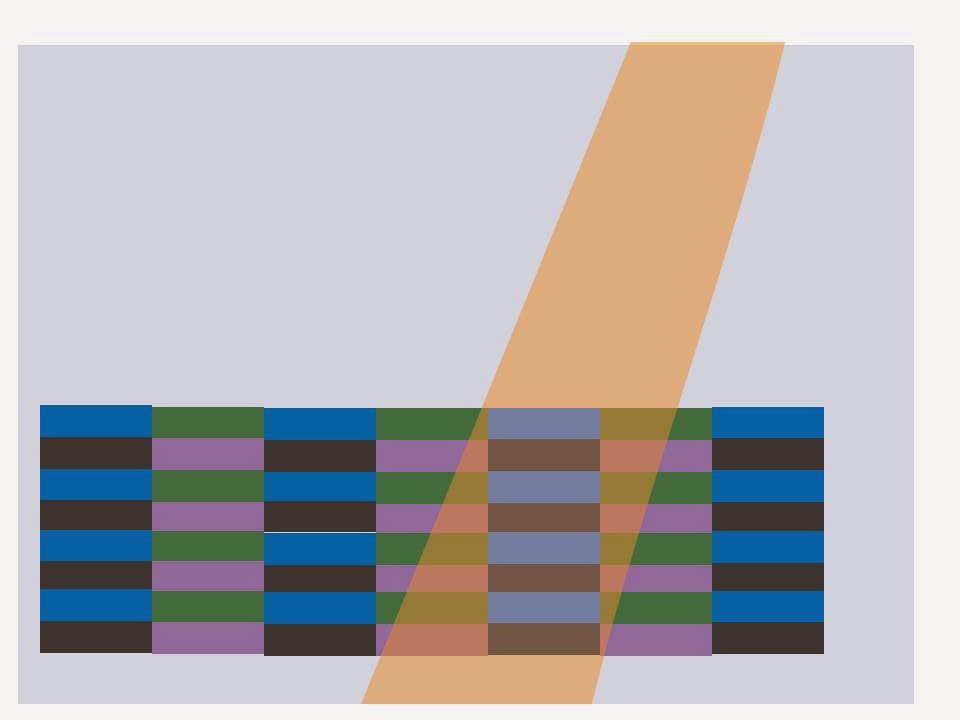
I have been having far too much fun with the wonderful color illusion of the dress that has been making the internet rounds lately!

I copied the main colors of the stripes from the photograph, and tried to create two different contexts, one where the colors are easy to interpret as blue and black:

another where it is easy to interpret them as white and gold:

It's a nice illustration of interdependence!

Maybe it is too shocking to believe, but...

Wednesday, October 22, 2014

Engaged Analysis

A thinking person will wonder about the nature of things. Which features of experience are real and which are merely ideas that color our perception? This distinction between a realm of reality and a realm of ideas may not be very useful though, despite its prevalence. Perhaps it is not as prevalent as it seems, but it certainly has become fundamental in the modern world, supported for example in the writings of Descartes. But how else can we think about things?

Let us think of the world as being composed of a network of situations or encounters. Each situation has some kind of polar or vector character. One can separate the two faces of a coin, but the result is simply two thinner coins, each of which again has two faces. A magnet is also like this. One can cut a magnet in two, separating its north pole from its south pole. But the result is simply two smaller magnets, each of which has a north pole and a south pole. With an encounter, the polar structure consists of subject and object, distinguishable but inseparable.

These elementary encounters are inter-related in a variety of ways. The twelve nidanas of Buddhist Abhidharma are one way to map out their flow. Perhaps my own thinking here is just a part of my own struggle to understand this map! Another map which is much more familiar to a modern industrial citizen, like me, comes out of organizational management theory. There is a cycle of activity which involves:

  1. recognizing a problem,
  2. envisioning future situations where that problem has been resolved,
  3. selecting one such future situation as a goal,
  4. considering possible paths to reach that goal,
  5. deciding to commit to a particular path,
  6. acting to move along that path,
  7. assessing the results of that action,
which leads to recognition of a new problem and another iteration of the cycle.

Another way that encounters are related is through composition or hierarchy. For example, assessing the results of an action can itself be a complex project consisting of many more detailed cycles of planning, action, etc. These sub-projects will surely have lateral relationships among each other as well.

The stable objects that we perceive would consist, from this perspective, as repeating patterns of encounters. My sketch of nested projects is surely no more than a tool to help jog one’s perception of the world from static objects to networked flows. The particular connections and flows involved in a particular situation might better be seen through a different lens.

For example, I might say a particular word at a particular point in a conversation. That particular utterance can be seen as a member in a variety of different families.

  • That same word has been used by various people at other times and places.
  • That word is one of the words I uttered during that conversation.
  • Uttering that word was one of my actions taken in pursuit of communicating an idea.
  • The uttering and the communicating were part of my effort to change someone else’s thinking about some topic.
  • This debate was just one of many where people who adhere to one particular school of opinion try to convince those of some other school. Perhaps this was a discussion about the advantages of internally geared bicycle hubs versus derailleur gearing. An outside observer might well note that I was just parroting the views commonly expressed on internet forums dealing with bicycles.
  • These debates might well reflect the tensions and conflicts between competing bicycle parts manufacturers or divisions within large manufacturers, together with their associated retailers, media representatives, etc.
  • At the same time, this word could reflect some habitual psychological drive where, for example, I tend to push terms and concepts to ever more abstract levels, both as a way to assert dominance but also as a way to isolate and insulate myself from the dangers of engaging with the uncompromising details.
  • And still the word could resonate with books I have been reading recently and the current trends in publishing and how editors use vocabulary to position their products within market categories of readers.
Any given encounter will be connected in countless such ways with every aspect or dimension of the world. In examining a particular situation it may be useful to sketch out a first few layers of these relationships, but the prioritization and limits to this elaboration need to be a function of the projects with which the examining person is involved. The question that can be answered is not so much, “What is this thing,” but rather, “How am I involved with this thing?”