Peter Davies provides this diagram for his keyboard layout:


Peter Davies provides this diagram for his keyboard layout:
Around 1980 I came up with a keyboard layout that could accommodate microtonality, including just intonation. Much more recently I have become interested in alternate key structures on top of microtonal pitch sets. Now I see how to remap my keyboard layout to support the alternate key structure I have been exploring. I would like to share that remapping here.
The keyboard layout covers a flat surface, like a table top. It consists of a hexagonal array of buttons, perhaps something like the chord buttons on an accordion.
 Of course this keyboard could extend any amount in any direction. A musician needs to be able to reach all the buttons and of course the cost of the instrument will increase with more buttons, but generally a practical instrument will be considerably larger than what I have illustrated here.
I have picked some selected buttons to have a different color, just as an aid for a musician to more easily keep track of location, a bit like the marks often placed on a guitar fretboard.
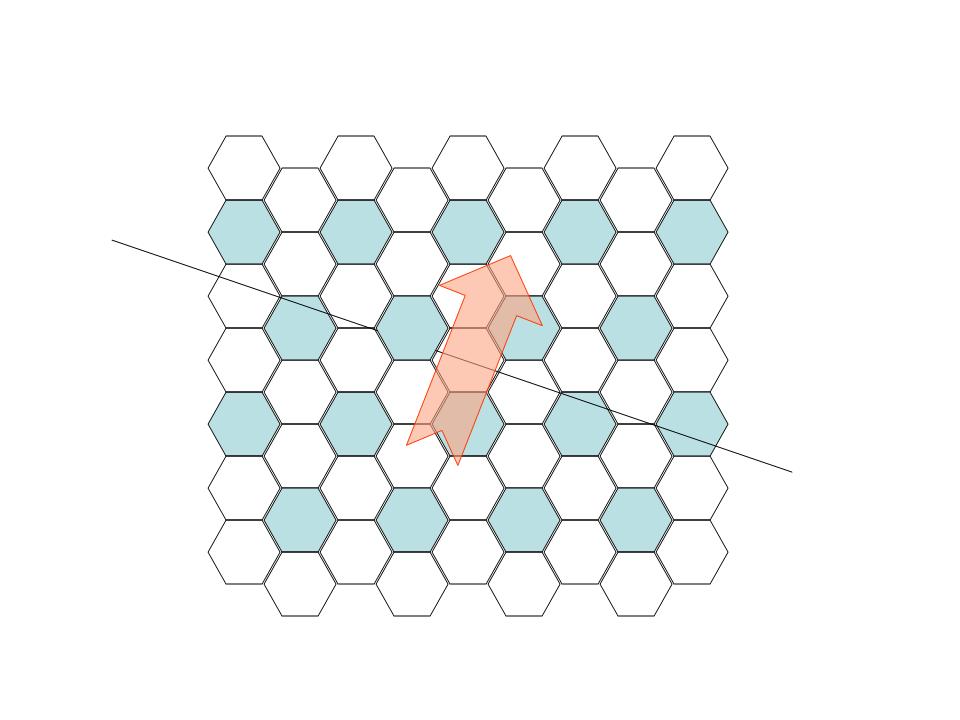 The arrow shows the direction in which pitch increases. The pitches are roughly constant along the line perpendicular to the arrow. I.e. by moving along that line one can explore very small pitch variations.
The notes are laid out on the keyboard by mapping geometric relationships to harmonic relationships. The fundamental harmonic relationship is the octave.
 Every pair of notes in a the same column with two buttons in between will be an octave apart. An octave is a frequency ratio of 2. To illustrate these frequency ratios, I have picked a button in the middle of the keyboard
to serve as a reference frequency and then will show the frequencies of the other buttons as a ration with respect to that reference button. So far all I show is just the two buttons that have octave relationships with the reference button. Of course on a real practical instrument one would generally like to have a much larger series of octaves, so the keyboard would be considerably extended in that octave direction.
Every pair of notes in a the same column with two buttons in between will be an octave apart. An octave is a frequency ratio of 2. To illustrate these frequency ratios, I have picked a button in the middle of the keyboard
to serve as a reference frequency and then will show the frequencies of the other buttons as a ration with respect to that reference button. So far all I show is just the two buttons that have octave relationships with the reference button. Of course on a real practical instrument one would generally like to have a much larger series of octaves, so the keyboard would be considerably extended in that octave direction.
The 1980 keyboard layout and the 2013 layout have the same geometrical representation for octaves. They start to split apart from there, though. The next harmonic relationship to consider is the perfect fifth. The 1980 layout uses the perfect fifth as the next building block.
 Every pair of buttons with the sort of diagonal relationship illustrated will differ in pitch by a perfect fifth. This lets us fill in many more frequency relationships, given that a just perfect fifth is a 3:2 frequency ratio.
The next harmonic relationship is the major third, which is a 5:4 frequency ratio in just tuning. Now things get a little complicated. Three major thirds make a just tuned ratio of 125:64 which is almost but not quite an octave. So the geometrical pattern for the harmonic relationships will be a bit irregular.
 The columns will follow a pattern of two major thirds, which combine to make a 25:16 ratio, and then a 32:25 ratio to make the complete octave. This completes the mapping of buttons to frequencies:
 One could use this keyboard layout to play in just tuning, but it can also be used with various temperaments. For example, the conventional 12 pitch equal temperament would look like:
 Now, instead of frequency ratios, the buttons are labelled with the number of steps up or down from the reference note. In this case the step size is 2^(1/12).
In just tuning every button has a unique pitch and one can find pairs of buttons that differ with arbitrarily fine spacing, limited only by the extent of the keyboard. Temperament limits the number of pitches within any interval. Thus with a tempered pitch set there will be multiple buttons mapped to any given pitch, for example:
 This geometrical mapping of harmonic relationships can also be mapped to the microtonal 53 pitch equal temperament:
 Here of course the step size is 2^(1/53). With more finely spaced pitches to choose from, there is less repetition of pitches among the buttons:
 Up to now this has been a description of the 1980 keyboard layout. In 1980 I had started with just intonation and was exploring various microtonal tempered pitch sets but it was not until the 1990s that I became interested in the 53 pitch equal temperament. Just a couple years ago I became interested in the kleisma, a small interval which is tempered by the 53 pitch set. The kleisma can be considered as primarily constructed from minor thirds. This opens up the intriguing possibility of a keyboard layout based on minor thirds:
 The 1980 layout had minor thirds for some of these geometric relationships but not for all. There is no way to keep all the minor thirds and all the perfect fifths in a single layout. So the new layout prioritizes the minor thirds and keeps only some of the perfect fifths. Of course musically this is unconventional and probably well nigh perverse, but all the same it might well open up some new and fruitful musical territory.
 This new layout actually preserves some of the frequencies of the 1980 layout:
 The mapping to 12 pitch equal temperament is exactly the same as the 1980 layout. The distinction between the layouts is subtle enough that it only appears in a microtonal layout such as the 53 pitch set.
 The tempering of the kleisma means there is quite a bit of pitch repetition in this layout:
 Maybe it's time to get out the soldering iron!
Proper bicycle tire pressure is a topic of endless fascination... and endless debate! On the one hand, what exactly is the goal? It is probably some combination of efficiency, comfort, handling, durability, etc. But the optimum pressure for reaching that goal will depend on many factors: the tire itself - its shape and construction - the load one is carrying, the surfaces on which one is riding, etc.
Frank Berto did some analysis, appearing here and here. Surley makes bikes with very fat tires and has some nice discussion about tire pressure here. There is also a thread on the Thorn forum, where I worked out a hypothesis that, using Berto's "uniform drop" theory, should vary proportionally with the load and inverse proportionally with the 3/2 power of the tire width.
I came up with a constant of proportion to give a reasonable fit with the published graphs by Berto. The fit is not very exact though... whether my formula gives better pressures than Berto's graphs can be left as an exercise for the reader/rider. In any case my formula is easily evaluated for a wider range of loads and tire widths than Berto's graphs cover.
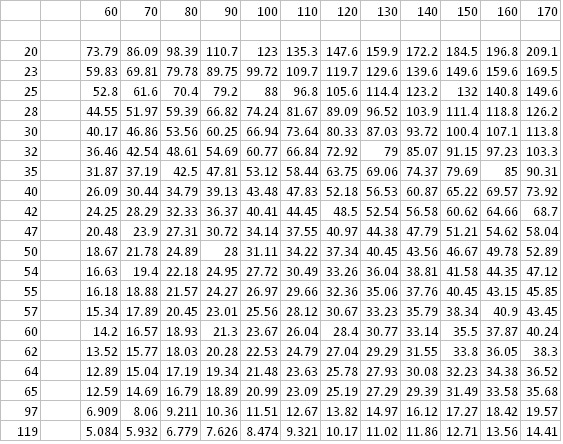
Here, then, is a table of suggested tire pressures. Across the top, find the load, in pounds, on the single wheel, e.g. roughly half the total load on the two wheels of a bicycle. Along the left side, find the width of the tire in mm. The number at the corresponding column and row of the table is then the suggested pressure in psi. Click on the table to get the full image which includes higher loads.
A big tub of water is composed of many water molecules. Each of these water molecules is doing its own particular thing, has its own particular location and velocity at one time and then a different location and velocity a bit later etc. If you watch a single water molecule dance around for a long time, you can get a sense of for its general pattern, what locations it spends the most time in, what velocities it is likely to have, etc. But another way to study a tub of water is not to watch a single water molecule over a long period of time, but to look at the whole collection of water molecules over a very short time. What are the locations and velocities that are most common among all those water molecules?
Well-behaved systems, systems where statistical mechanics works well, systems that we can understand, are ergodic. This means that two approaches above will give the same results. I can watch a single molecule for a long time to learn about the most common locations and velocities, or study all the molecules for a short time. Either way, the distribution of locations and velocities will be the same.
When we read about precious human birth, the illustrations provided are about other sentient beings. For example, when we looking around we see many more insects than we see human beings. What we should infer from this is that if we look at our own series of births, many more of them will be as an insect than will be as a human.
The reliance of this argument on the ergodicity of samsara is quite exact. An individual sentient is like an individual molecule. The birth realm of a sentient being is like the location and velocity of a molecule. The distribution of an individual's series of births among the realms matches the distribution of births of all beings at any single time, in just the way that the distribution over time of the locations and velocities of a single molecule matches the distribution at a single time of a whole collection of molecules.
I'm not sure what exactly the value of this observation might be. It might help to clarify for some people the notion of a precious human birth. For some people, it might help strengthen their faith in the Buddhadharma, to see how the reasoning incorporated in the Dharma is at least similar in sophistication to that of modern science. Perhaps it could be a step along the way to a mathematical model for samsara, the evolution of experience of deluded beings. Ultimate truth surely transcends any sort of mathematical or logical analysis, but clear reasoning can surely help us let go, step by step, of our clinging to delusions.
Nowadays with a smart phone one can do product research right in the hardware store. A quick search of the internet will provide an endless list of product reviews. Interpreting these is a bit challenging, though. The manufacturer may well have planted positive reviews with a convincing but unfounded aura of objectivity. On the other hand, various grouches and trolls delight in trashing whatever they encounter, highlighting every imperfection but still leaving one no wiser about which bulb to choose. It's a big help if one can find a review at a site one knows, from a source one knows well enough to be able to trust. Having found a few such informative reviews on candidate light bulbs, one can then search too to see if there are better prices close by.
That might already sound a bit overwhelming, but buying light bulbs isn't actually even that simple. It's not just that LED bulbs have entered the arena, with yet higher prices, longer lives, and higher efficiencies. What makes the lighting aisle especially bewildering these days is how quickly the prices on LED bulbs are dropping. If I know that the prices for these top-notch bulbs will drop 30% in six months, my smart strategy might be to buy a cheap incandescent to get me by in the mean time, and then come back shopping again after the price reduction. Smart choices aren't just a matter of how the market looks today, but depend too prices in the future.
Shopping for lighting fixtures is much more future-oriented than shopping for bulbs. A single fixture might last through dozens of bulbs. The fixture is also much bigger investment than a bulb, often including a significant cost for installation. If a fixture uses any sort of less common type of socket or requires any special shape of bulb, then buying the fixture becomes a gamble that the bulbs it requires will remain available for long enough in the future to get one's money's worth out of the fixture. In the best of worlds, the required bulbs will even be available at good prices!
Wouldn't it be wonderful to have a smart phone app or a website that could give accurate forecasts about product availability and pricing? Of course such a tool's usefulness would go far beyond light bulbs and lighting fixtures. It could have averted the entire housing and financial crisis! Too often people took out mortgages on houses than they couldn't afford, expecting to be able to resell the houses at higher prices before they got too far behind on their mortgage payments. If they had known that housing prices were going to stop climbing, they wouldn't have bought the houses in the first place and the foreclosures would have been averted.
Given than we can't even forecast the weather more than a few days ahead with any degree of accuracy, it seems unlikely that reliable forecasts of housing prices are likely to become available. On the other hand, as computer models of changing atmospheric pressure and temperature get ever more sophisticated, and as more weather stations are deployed across the land and sea and in orbit, weather forecasting does indeed get more accurate, even if only incrementally. Are housing markets somehow inherently more difficult to forecast than the weather?
When planning a big project, it is often advantageous not to tip one's hand. A large electrical manufacturer might want to introduce a new line of lighting fixtures that will require a new type of bulb which that manufacturer also plans to supply. Perhaps the main appeal is the fixture or perhaps it’s the bulbs, but either way if the manufacturer is the sole supplier of each then the sales of one will drive its sales of the other. But if word leaks out about the new type of bulb, then competing manufacturers will be able to enter the market at the same time or even ahead of the one that initiated the move.
Suppose that an accurate market forecasting tool were available. Surely it ought make the job easier for those competing manufacturers. The forecasting tool would tell them in advance about the new type of bulb that would be appearing soon. But such a tool could also be used by the manufacture that plans to initiate such a move. If they see that the tool has prematurely revealed their plans and spoiled the early mover advantage they would have gained, they could just change their plans to something a bit different from what the tool was forecasting, regaining their market advantage.
It's hard to believe that there's something behind the weather that delights in raining on our picnics, harder still that something would read the weather forecast to infer our picnicking plans, the better to steer the rain our way. But in the marketplace there is much to be gained by spoiling the plans of others, and utter certainty that any available forecast will be used to that end. For every player who tries to use a forecast to gain an advantage, there will be a player who acts to steer things against the forecast to tilt the advantage in their own direction. Forecasting markets is a much nastier kettle of fish than forecasting the weather!
In our time and place, community is a rather ethereal concept. Our modern technologies of communication and transportation seem to have been the primary agents of the dissolution of community. We have ready access to a few hundred million other people, those of us living on the grid, on the network, on the web - pulverizing our relationships to bits, to broken fragments. Such a broken system cannot sustain itself, and indeed the signs of collapse are everywhere. How far we have to fall before we rebuild enough integrity to revitalize our relationships and make richly meaningful lives again normal, that is our crucial and urgent challenge.
Archdruid John Greer proposes that "devising a framework for adult education outside the grip of the current American education industry is one of the most pressing needs of the decade or two right ahead of us." Perhaps it is not going too far to extend this proposal, to see learning as the binding fabric of human community. Learning is life. This points to the real pathology of our science today, which has far too much the smell of death, of an escape from the grappling and tangling with the ambiguities and paradoxes of raw experience, an escape into the pure clean clear realms of the ideal, of mathematics and theory and abstraction.
We need widespread local venues where learning can be shared, learning that promotes engagement with the realities of experience, of daily life. Some of these might be workshops oriented to somewhat specialized crafts. But the general foundation needs to be the cultivation of how to live a sane life. The basic skills of living need to be taught, rooted in our world today and reaching to the world we envision for tomorrow.
Gardening, nutrition, physical exercise, the skills of reading and writing, household finance, home repair, bicycle and automobile repair, computer skills, crafts such as sewing and woodworking, arts like painting, sculpture and music, how to manage interpersonal conflicts, the basics of working with government agencies and other large scale institutions such as insurance companies… these sorts of down to earth basic skills whose sharing can provide not only the raw material for revitalized community but also the context for critical thinking. It is through vital engagement with the substance of experience that the sublime arises, not by chasing after abstractions. Theory and abstraction properly work when they enhance our engagement with experience. They are means, not properly ends.
Let us learn together, to reconnect through the world, to each other.
This comparison got me thinking. To a large extent the practice of science is highly concentrated in elite institutions: our great research universities, along with a few government and industrial research labs. Perhaps it is also the election cycle that is coming to a close over the next few hours that has also reminded me, for example with the reports of bizarre beliefs about the human reproductive system, that the scientific outlook is not so very widespread.
On the one hand the challenge is real enough of how to steer science toward the actualization of its greatest potential for benefiting humanity and the planetary biosphere. This challenge takes for granted the continuing vitality of our scientific institutions. But a very real challenge to that vitality may well be sitting on the other hand.
I've been reading Linda Lear's biography of Beatrix Potter. Potter was evidently a fine amateur naturalist. Her illustrations for her children's books grew out of her botanical drawings, from which also grew her interest in the biology, in particular of mushrooms and lichen. She was a real pioneer of lichen biology, perceiving their symbiotic nature far ahead of almost anyone else. Lear tells us that it was just around the time of Potter's insights on lichen, around 1900, that botany was becoming professionalized, so that the insights of an amateur were discounted. Of course the fact that Potter was a woman didn't help matters either.
If science is to survive then it seems that somehow it must become more localized and to recover the appreciation it once held for the amateur. This is quite distinct from any sort of indulging of incompetence. To some extent the current professionalized approach to science can actually provide more support for incompetence, since the competition for professional status and position can overshadow the quest for truth. The competence we need to cultivate has to do with willingness to break through confused thinking despite the cost, rather than the exploitation of confusion for profit.
The increasing financial, political, and natural stresses on our scientific institutions, from fiscal cliffs to surging seas, will shake them profoundly. This shaking can provide an opportunity for a new more vital vision, for a science that inspires and thrives as a pervasive element of society.


