I rearranged the lattice and added the new pitch class. The balance is clear!

I rearranged the lattice and added the new pitch class. The balance is clear!
Instead of making as big a scale as possible that still blocks traversal of the syntonic comma, my idea here was to make a smaller scale that more narrowly focuses on traversing 12288:12005. Another feature of the bigger scale is that it can be constructed with a single generator: it was just a sequence of intervals of size 2. This new scale with 11 pitch classes does have a pretty regular structure: the scale intervals are mostly size 2 and 6, with a single size 3 interval. I have seen where people build scales with very exact mathematical order... the scale I am using here was just something I engineered in an ad hoc way.
Scale lattice diagrams helped me engineer this scale. I was looking at a lattice for the conventional 12edo diatonic scale:

Here the blue arrows show major third intervals and the green arrows show perfect fifths. Most chords are subgraphs connected by these consonant intervals. One could add further arrows for minor thirds, but these are implied by the arrows already in the lattice. A traversal of the syntonic comma appears as a loop on the lattice, e.g. 0, 7, 2, 9, 4, 0. Moving by four perfect fifths arrives at the same pitch class as moving by a major third.
There is an awful lot of good music that can be built from this diatonic scale. The lattice doesn't look so complicated, so my idea here was to make a scale in 43edo whose lattice doesn't look too terribly much more complicated:

This lattice includes red arrows for the interval 7:4. Traversing the comma 12288:12005 appears on the lattice as a loop, e.g. 0. 8, 16, 24, 32, 18, 0.
This scale looks related to 5edo. It has 5 clusters of pitch classes: {40, 0, 2}, {8, 10}, {16, 18}, {24, 26}, and {32, 34}. Hmmm, maybe it would be more symmetric if pitch class 40 was ommitted. But that would leave a pretty big hole in the scale, from 34 to 43, 9 steps. More to explore!

This piece traverses the comma 4096:4095 eighteen times. The repeating staircase pattern in the above score is indicative of this looping structure.
I wanted to construct a piece that traversed the comma 4096:4095, and went searching for a good tuning system, a good equal division of octaves, to do this.

This table guided me to 140edo. I looked through thousands of possible equal divisions of the octave. First I filtered out just those that temper out 4096:4095. 4096 is a power of 2. Most of my software treats octaves as equivalent notes, so powers of 2 tend to disappear. The graphical score above works this way: the vertical axis is pitch class, i.e. the pitch with the octaves erased. 4095 = 3*3*5*7*13, so the search for a good tuning system involves those primes. In 140edo, the prime number 3 is approximated by 222 steps, 5 by 325 steps, 7 by 393 steps, and 13 by 518 steps. So the composite number 4095 is represented by 222 + 222 + 325 + 393 + 518 = 1680 steps. But 1680 = 12 * 140, i.e. 1680 is exactly 12 octaves. 4095 and 4096 are both exactly 1680 steps in 140edo, so we say that 140edo tempers out 4096:4095.
This table also shows the error involved in the various tunings. E.g., the prime number 3 is actually 221.8948... steps of 140edo, which the tuning will approximate by 222 steps. The error for the prime 3 is thus 0.1052 of a step. The table shows the errors for all the primes involved, and then a combined score. I sorted the tunings by this combined score. 441edo is a bit better than 140edo, but then it is also nice to have a smaller division of the octave, so I decided to use 140edo instead.
The main thing I am exploring here is how the meaning of unusual intervals can be clarified by a rich harmonic context. This piece pushes my usual pattern in two ways. This piece has six voices; usually I limit myself to four. Also, this piece uses intervals that approximate frequency ratios built with the prime numbers 2, 3, 5, 7, 11, and 13; I rarely go beyond 7. Intervals such as 14:13 and 15:14 have been permitted in the construction process of this piece. 14:13 is approximated by 29 steps of 270edo; 15:14 by 27 steps. So the tuning system has the precision to distinguish between these intervals. I suspect that if these intervals were heard in isolation, they would be practically impossible to distinguish. But if a richer context is provided, perhaps in the form of tetrads 9:11:13:14 and 9:11:14:15, the ear would have more information and would be able to hear the difference. Anyway, that's what I am trying to do here. With six voices, the more esoteric intervals will occur in combination with less esoteric intervals, and the ear will be able to make some sense of what is happening.
This is a graph of the piece, with time in seconds on the horizontal axis, and pitch class on the vertical axis. The pitch class is the pitch folded into a single octave. The vertical axis labels give the fraction of that single octave.

This graph shows that there is further structure to this piece, that should help clarify the meaning of the intervals. This piece traverses the comma 2080:2079 twelve times.
270edo is such a precise tuning system, one might think it to be effectively equivalent to just intonation, where the intervals are exact rational frequency ratios, rather than approximations. But 270edo does temper out many commas, as indeed any edo, any equal division of the octave, must. Another way to think about tempering out 2080:2079 is that 270edo maps 77:65 and 32:27 to the same interval.

This is a table that shows, for three tuning systems, those that divide octaves into 12, 31, and 43 equal parts, how well they approximate these fundamental intervals. The conventional 12 equal steps per octave has the chief downside that the major third is off by 13 cents, which is definitely noticeable. The 7:4 interval is so far off, 31 cents, that it can't practically be used in conventional tuning. Of course the conventional system has its advantages: 12 is a relatively small number which makes it feasible to build and play musical instruments that use this tuning; and of course these instruments are very widespread, together with music that uses the tuning, theory in terms of the tuning, etc.
31edo, the tuning that divides octaves into 31 equal steps, is very close to quarter comma meantone. The syntonic comma, the frequency ratio of 81:80, is about 21 cents in size. The perfect fifth in 31edo is a bit more than 5 cents flat, i.e. about a quarter of a comma. A perfect fifth in conventional tuning is only about 1/11 of a comma flat, i.e. it is much more accurate. But by flattening the perfect fifth more, 31edo can represent the major third with great accuracy. By whatever fluke of mathematics, 31edo also approximates 7:4 very well.
43edo is similar to 31edo. It flattens the perfect fifth a bit less, at the cost of a greater error in the major third. The error in 7:4 is considerably greater, but still not too bad.
Another key feature of tunings is which commas are tempered out. All three of these tunings temper out the syntonic comma, and are therefore known as meantone tunings. Conventional music theory and musical notation is based on meantone tuning, whose history goes back maybe five hundred years. For each of these meantone tunings, moving four perfect fifths, e.g. from C through G, D, and A, to E, has the same endpoint as moving a major third and two octaves. The table above makes this easy to check. In conventional 12edo, 4*7 = 4 + 2*12 = 28. In 31edo, 4*18 = 10 + 2*31 = 72. In 43edo, 4*25 = 14 + 2*43 = 100. Conventional music does not distinguish between the E that is four perfect fifths from C and the E that is a major third and two octaves from C. So a tuning system that can be used with conventional music should map these two different combinations of intervals to the same final pitch.
The 7:4 interval is not used in conventional music. There are other commas, such as 225:224, that are formed by combining 7:4 with other fundamental intervals. Both 31edo and 43edo temper out this comma. Another, more esoteric, comma, is 12288:12005. In 43edo, if one moves by 7:4 four times, this is 4*35 = 140 steps. From there, move further, by a major third: 140+14 = 154. This is the same pitch one arrives at by moving a perfect fifth and three octaves: 25 + 3*43 = 154. This comma is not tempered out by 31edo: 4*25+10 = 110, while 18 + 3*31 = 111. I decided to build a piece of music around this esoteric comma 12288:12005.
An effective way to structure a piece of music is by using a scale. A tuning system provides a set of pitches; a scale defines a useful subset of these. For example, conventional tuning provides 12 pitches per octave; a diatonic scale picks out 7 of these. A scale will support traversing some commas that are tempered out by the tuning system, but not all such commas. So, for example, a diatonic scale supports traversal of the syntonic comma: there are diatonic scales that include all the notes C, G, D, A, E that traverse the syntonic comma. Another comma tempered out by conventional 12edo is 128:125 - moving three perfect fifths is the same as moving an octave. But there is no diatonic scale that includes all the notes in the traversal C, E, G#.
I have seen mention of systematic ways to construct scales, but I am very much a beginner in all this. I like to learn by exploring! I just try a variety of scale structures to see what might work. What I landed on here is a very regular structure: a scale that includes 21 notes per octave out ot the full set of 43. Pick a starting note, then take the note two steps higher, and again two steps higher, until one has 21 notes in the set. So the scale will be made almost entirely from steps of size 2, except for a single interval per octave of size 3.
I use tonnetz diagrams to work out how scales function. The standard tonnetz diagram is based on the fundamental intervals of the perfect fifth and major third:

Each number represents a pitch class. Moving right one cell corresponds to a perfect fifth, e.g. from 0 to 25. Moving up one cell corresponds to moving a major third, e.g. from 0 to 14. All the notes here are folded into a single octave. The numbers in the diagram repeat a lot: this is nature of tempered tunings. One can start at a 0 cell, move four steps to the right: 25, 7, 32, 14; and then down one cell to arrive at another cell with a 0. This is how a syntonic comma is traversed. The notes in this scale are marked in green: one can see that there is no way to traverse a syntonic comma using this scale. It is an unconventional scale!
On the other hand, starting at a cell marked 0, move two cells to the left and then down two cells. One arrives at a cell marked 8. Moving the interval 7:4 from there, i.e. 35 steps, brings one back to a cell marked 0. This is a traversal of the comma 225:224 and can be done completely within this scale. The scale supports the traversal of this comma.
The intervals 7:4 are not explicitly shown on this diagram. I want to construct music from three fundamental intervals, 3:2, 5:4, and 7:4. But a computer screen or a piece of paper only has two dimensions! So there is a bit more work involved to trace the pathways in the three dimensional space.

Here is an unconventional tonnetz diagram, a different perspective on the three dimensional network of notes and intervals involved here. This tonnetz diagram shows perfect fifths (25 steps, horizontal movement) and 7:4 (35 steps, vertical movement). Again the notes of the scale are highlighted in green. Start at a cell marked 0 and move down four cells and then to the right one cell. One arrives at a cell marked 14. This is a major third from a cell marked 0. Major thirds are not explicitly represented on this unconventional tonnetz diagram, but this tonnetz diagram shows that this scale supports the traversal of the esoteric comma 12288:12005.
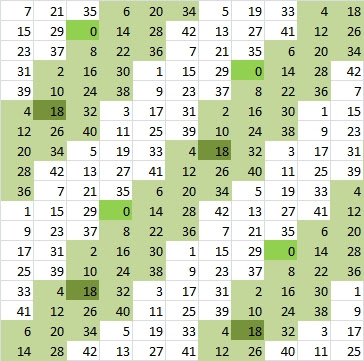
Here is a third perspective on the space of notes and intervals, showing major thirds horizontally and 7:4 vertically.
Enough with the diagrams! Here is a new algorithmic composition in 43edo that uses this scale to traverse the comma 12288:12005.
This puzzle is essentially a variation of sudoku. A sudoku solution is a 9x9 array of numbers; a gridlexic solution is a 5x5 array of letters. In both puzzles, one starts with some small subset of the array already filled in, e.g.

A gridlexic solution will have 5 distinct letters in the solution. The puzzle presents 9 possible letters. Part of solving the puzzle is to figure out which 5 are in the solution, and which 4 are to be left out. Of course, if a letter is in the initial set of clues, then it will certainly be in the solution!
Each of the 5 solution letters must occur exactly once in each row, column, and outlined sector. In sudoku, the sectors are 3x3 rectangles. In gridlexic, they are irregularly shaped regions containing 5 cells. In addition to these sudoku-like rules, the letters must form words in the horizontal or vertical highlighted regions. In this example puzzle there is one vertical word with 4 letters, and one horizontal word with 4 letters. These words overlap at one cell.
Each of the 5 distinct letters in the solution will occur in at least one of the words in the solution.
Here is the solution to this example puzzle:

Each row has exactly one occurrence of each of the 5 letters in the solution, e.g.:

Each column has exactly one occurrence of each of the 5 letters in the solution, e.g.:

Each sector has exactly one occurrence of each of the 5 letters in the solution, e.g.:

The vertical highlighted cells form a word:

The horizontal highlighted cells form a word:

We certainly hope it is a fun puzzle to play!
Tuning and consonance are fundamental. I can constrain pitch selection to a scale, to a subset of the full set of pitches provided by the tuning system. Vertical relationships can be regulated, requiring chords to conform to some set of shapes. A variety of horizontal relationships, adjacency in a voice but also across longer scale repetition structures, can be guided more or less rigidly to some set of consonant intervals.
The large scale repetition structure of the piece is another aspect of constraint. Low dimensionality means few horizontal relationships, allowing greater freedom. High dimensionality introduces many horizontal relationships, clusters of clusters, which constrain the pitch selections.
The thermodynamic approach of my algorithm provides a temperature parameter. High temperature allows more freedom, low temperature imposes more constraint. There is generally a transition where long range order emerges, with fractal fluctuations at the transition.
In this new piece I don't target the phase transition. I gave the piece a high dimensionality, so it was tending to jump into a very orderly state. To forstall this, I initialized it randomly and then cooled it just enough to let a moderate amount of order emerge... that's another dimension of the freedom-order interplay: how the pitches are initialized, and how long the consonance optimizer is run.
This piece is in 171edo and uses the same chord shape constraint as the piece I posted a few days ago. But this piece has three voices instead of five. This gives the piece more freedom to move harmonically. My idea was that this would reduce the tendency to fall into a highly ordered state... but it didn't seem to work that way! I thought I could get away with increasing the dimension; I did keep the higher dimension, but just reduced the amount of pitch optimization jostling to preserve some of the initial freedom.


